

Before getting your first dog or cat, make sure you have the time, space and money for one, consider adopting, set up a quiet room with the basics, keep the first week calm and predictable, and register your new pet with a vet as soon as possible. In a Mumbai flat, a new puppy or kitten changes your routine from night one. This first time dog owner guide covers dogs and cats: what to buy, the first week, vet visits, training and when to call a vet.
Key Takeaways
Only get a pet if you are ready: dogs need company, exercise, a healthy diet, a bed and toys.
Have the supplies ready before your pet comes home, and give them a quiet room or den.
Rescue dogs may follow a rough 3-3-3 pattern: three days, three weeks and three months to settle.
Register with a vet early, keep vaccinations up to date, and call a vet straight away if your pet struggles to breathe or collapses.
What Should You Know Before Getting a Pet?
A pet needs your time, company and space every day, so get one only when you are ready. The PDSA, a UK vet charity, puts it simply in its guide to getting a dog: "Remember to only get a dog if you're ready."
It explains that "Dogs are sociable animals and need the company of their owners." "They need a loving home, plenty of exercise, a healthy diet, a comfy bed, toys to keep them occupied."
Cats need the same honest check. Cats Protection, a UK cat welfare charity, frames the decision around whether "you do have the space, time and money to dedicate to a cat" in its post on things to know before getting your first cat.
Before you commit, think about:
Time: who will be home, and for how long each day.
Space: where the bed, bowls and litter tray or toilet spot will go.
Money: food, vet visits, vaccinations, flea and worm treatment, supplies and grooming.
Lifestyle: how active you are, and whether everyone at home agrees.
Which Is the Best Dog for First-Time Owners in India?
The best dog for a first-time owner is one whose energy and needs match your lifestyle, and adopting is a good place to start. The PDSA says "If you love being outdoors and walking for miles, then a more active breed will be better for you." If you prefer staying in, it suggests a smaller dog that needs less exercise may suit you better, and recommends asking a vet or vet nurse for breed advice.
On adoption, the PDSA says: "We'd always recommend adopting a pet."
For cats, the PDSA's guide to getting a cat says "we'd always recommend considering adopting an older cat instead" of a kitten.
What Do You Need Before Bringing a Dog or Cat Home?
You need a bed, food and water bowls, the right food, ID, a lead, toys and basic grooming tools ready before your pet arrives. The AKC (American Kennel Club), a US dog breed registry that publishes care advice, says in its new puppy checklist that most owners should have "basic grooming supplies ready before arrival", along with a harness, lead, crate, bed, bowls, puppy food, chew toys, training treats and waste bags.
First Time Dog Owner Checklist
The PDSA's checklist for a new puppy includes:
"A crate and/or bed"
"Food and water bowls"
"A complete puppy food"
a collar, ID tag and lead
"Lots of toys"
"A brush or comb for grooming"
First Time Cat Owner Checklist
A new cat's room needs food and water bowls, a bed and a scratching post. International Cat Care, a cat welfare charity, adds two tips in its guide to helping a new cat or kitten settle in:
a litter tray: "Place the litter tray in a discreet corner of the room, with the food bowl on the opposite side"
a hiding place: "place a cardboard box on its side with a thick fleecy blanket inside"
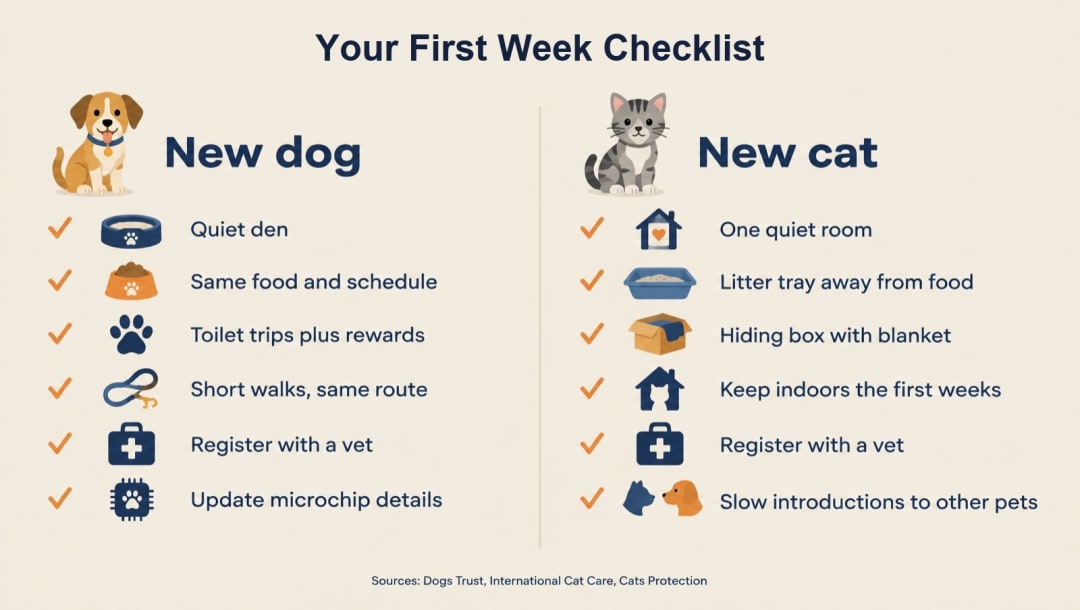
How to Settle a New Pet in the First Week
Keep the first week quiet, predictable and on your pet's terms.
1. Set Up a Quiet Den or Room
Dogs Trust, a UK dog welfare charity, advises in its guide to settling a rescue dog: "Set up a den area in a quiet space away from the main, busy thoroughfares." For a kitten, International Cat Care says to "choose a quiet room for your kitten to live in for the first few weeks."
2. Let Your Pet Set the Pace
Dogs Trust says: "Let them settle in at their own pace."
3. Start a Routine and Keep Food the Same
Dogs Trust advises: "Start to create a routine and stick as closely to it as possible." Its guide to a puppy's first day adds that "Sticking with the same food and eating schedule for the first few days will help them ease into their new life." Our advice: ask the shelter or previous home what your pet eats and when. For kittens, the PDSA notes that "a young kitten will often have different needs to an adult", so ask your vet before changing food, and see our guide to human foods dogs can and can't eat before sharing scraps.
4. Begin Toilet Training on Day One
For puppies, Dogs Trust says: "Let them out regularly and reward them every time they go to the toilet outside." Then "only reward them when they're finished", and "don't shout at, or punish them in any way as they won't understand why." For cats, keep the litter tray in the room, away from food.
5. Keep Walks Short and Familiar
Dogs Trust says "over the first few days you want to keep walks short and in the same location."
6. Introduce Other Pets Slowly
International Cat Care warns: "Don't rush to introduce your new kitten or cat to other cats and dogs in the household", adding "this must be done slowly and carefully."
What Is the 3-3-3 Rule for Dogs?
The 3-3-3 rule is a rough guide to how a rescue dog adjusts: three days to decompress, three weeks to learn the routine and three months to fully settle. The AKC sets it out in its article on questions to ask when adopting from a rescue:
"first three days for initial decompression"
"first three weeks for learning routines and understanding they are safe"
"first three months to bond with you and fully settle"
The AKC notes "You may have a shorter or longer experience based on an individual dog's needs," but says "this timeline creates a good basic guide to build from."
When Should a New Pet See a Vet?
Register a new pet with a vet and book a check-up soon after it comes home. Dogs Trust says "you also need to update their microchip details, organise pet insurance and register with your local vet." The PDSA adds that "you'll also need to take them to the vet for a check-up" and "you must make sure that their vaccinations are fully up to date."
For cats, Cats Protection's hub for first-time cat owners says "Finding a vet and getting your cat registered as soon as possible is important for their health."
The PDSA tells cat owners to "Have them microchipped" and "Treat them regularly for fleas and worms". For timings in India, see our dog and cat vaccination schedule for India and our guide to puppy vet visits in the first year.
The AKC's guide to preparing for a new puppy also says to "learn the location of your nearest emergency veterinary clinic."
How Do You Start Training and Socialising a Puppy?
Start gentle, reward-based training the day your puppy comes home. The AKC's puppy training timeline says "Training can begin as soon as your puppy comes home, often around 8 weeks old."
It adds that "The 8–16 week window is especially important because puppies are highly receptive to new experiences."
The AKC says "Positive-reinforcement training can help dogs learn at any age", so adopted adult dogs can learn too. Be patient with toilet training: "Housetraining can take several months." For a realistic timeline, read how long it takes to train a dog.
What Is the Best Advice for First-Time Dog Owners?
The best advice is to be ready before your dog arrives, then stay calm, consistent and patient:
choose a dog that suits your lifestyle, and consider adopting
give your dog a quiet den and a steady routine
register with a vet and keep vaccinations up to date
reward good behaviour, and expect settling in to take weeks or months
Common Mistakes to Avoid
Getting a pet before you have the time, space or money for one.
Shouting at or punishing toilet accidents.
Rushing introductions to other pets.
Letting a new cat outside too soon.
Putting off registering with a vet.
When Should You Call a Vet?
Call a vet straight away if your pet struggles to breathe, collapses or gets rapidly worse. The PDSA's guide to pets struggling to breathe says "Struggling to breathe is a life-threatening emergency." Take your pet to the vet immediately if they:
"are unable to breathe"
"have collapsed"
"have white, grey or blue gums"
"are getting rapidly worse."
The PDSA's cat health guide says "We recommend taking your cat straight to the vet if you notice any of these signs of illness", including:
"Sickness or diarrhoea"
"not eating as much as usual"
"drinking much more or less than normal"
"signs of pain, such as not wanting to be touched"
If you are unsure, call your vet. A groomer is not a vet.
When Can a New Pet Be Groomed at Home in Mumbai?
FurDial grooms new pets at home once their core vaccinations are up to date. Its groomers come to your home across Mumbai, Thane, Navi Mumbai and Vasai-Virar, so there is no cage and no car ride. Every groomer has 5+ years of experience.
Our advice: before the first groom, get your pet used to short, gentle brushing sessions with treats and praise. For cats, see how often a cat should be groomed. If your new pet is anxious, mention it in the booking note; the groomer may pause or reschedule if that is safer.
For dogs, The Clean Aesthetic (₹1,699, about 90 minutes) covers a deep conditioning bath, blow dry, brush out, nail clipping and filing, and ear, paw and eye cleaning. For cats, The Glow Up (₹1,199, about 45 minutes) is a dry bath with no water or dryer, plus ear, eye and paw cleaning. Prices include GST, with no travel charge. See all grooming packages and prices.
Frequently Asked Questions
How Often Should a Cat See a Vet?
Cats Protection says "You should take them to the vet at least once a year for a check-up." Call sooner if you notice signs of illness.
How Long Should a New Cat Stay Indoors?
Keep a new cat indoors for the first few weeks. International Cat Care recommends "at least two to three weeks", while Cats Protection says "it's a good idea to keep them indoors for the first three to four weeks after you bring them home."
When Should a Cat Be Neutered?
The PDSA recommends that "all cats are neutered as soon as they are old enough (from 4 months onwards)." Ask your vet when is right for your cat.
Final Thoughts
For new pet parents, the first weeks are about preparation and patience. Check you are ready, consider adopting, have the supplies in place, keep the first week calm, and get your new dog or cat registered with a vet early.
When your new pet is vaccinated and ready for a gentle first groom, book a FurDial groom at home.