
Puppies and kittens need several doses of core vaccines, starting no earlier than 6 weeks of age and repeated every few weeks until they are at least 16 weeks old, then a booster at around 6 months and further boosters on the schedule your vet sets. Whether you have a new Indie puppy in Thane or a kitten in Andheri, the first year of vet visits matters. This guide explains the dog vaccination schedule India pet parents usually follow, the cat schedule, rabies and leptospirosis, side effects, and why the yearly check-up is worth keeping.
Key Takeaways
Global vet guidelines say every dog and cat should get core vaccines, and rabies vaccines count as core wherever rabies is endemic.
The puppy and kitten series should end at 16 weeks of age or older, with a booster at or after 26 weeks.
Some vaccines, such as leptospirosis for dogs, are given every year, and an annual health check covers far more than injections.
Always follow your vet's schedule, and keep your pet's vaccination record safe.
What Vaccines Does My Dog or Cat Need in India?
Every dog and cat needs the core vaccines, and your vet may add non-core vaccines based on lifestyle and local risk. The WSAVA (World Small Animal Veterinary Association), a global body representing vets who treat pets, sets this out in its 2024 guidelines for the vaccination of dogs and cats. It says it "strongly recommends that ALL dogs and cats should receive the benefit of vaccination".
It defines core vaccines as "those that ALL dogs and cats should receive, after considering their lifestyle and the geographical areas in which they live or to which they travel".
On rabies, the WSAVA is clear: "In areas of the world where rabies is endemic, vaccination against rabies virus should be considered essential for both dogs and cats (i.e. rabies vaccines are core in those places), even if there is no legal requirement for this."
Non-core vaccines are those "highly recommended in animals whose geographical location and/or lifestyle" puts them at risk. The WSAVA says choosing them needs "A careful conversation between veterinarian and owner".
What Are the Top 3 Vaccines for Dogs?
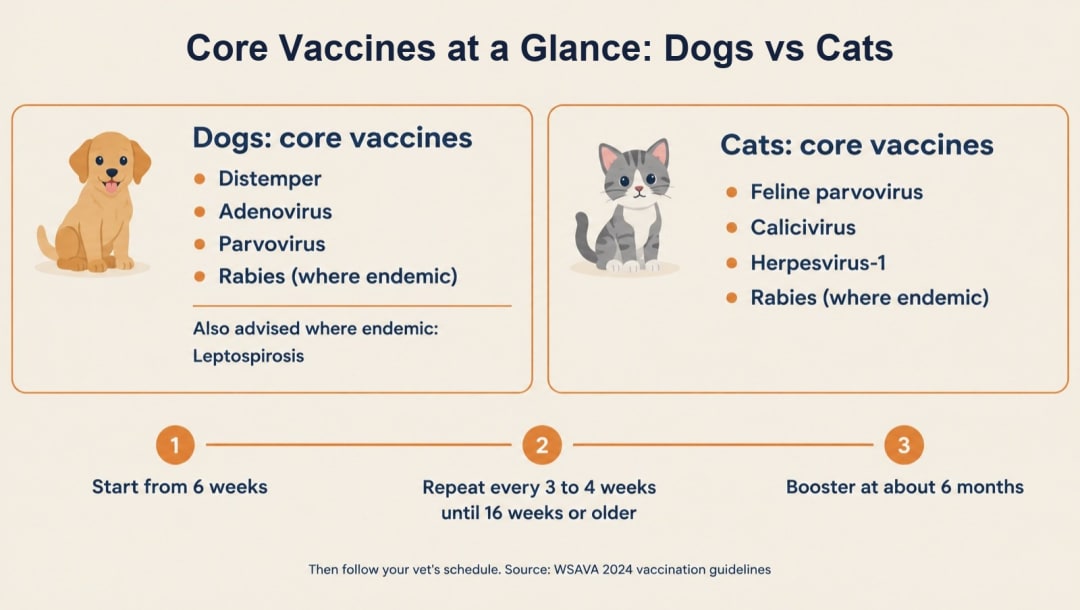
The three core vaccines for dogs everywhere protect against canine distemper virus, canine adenovirus and canine parvovirus, according to the WSAVA.
Rabies is core too wherever it is endemic, and where leptospirosis is endemic the WSAVA highly recommends vaccinating all dogs against it (see below).
What Is the Puppy Vaccination Schedule in India?
Puppies start their core vaccines no earlier than 6 weeks of age and get repeat doses until they are at least 16 weeks old. The WSAVA's vaccination table for pet dogs says: "Start no earlier than 6 weeks of age. Revaccinate every 3–4 weeks until 16 weeks of age."
The WSAVA guidelines then advise a booster "at or after 26 weeks of age (rather than waiting until 12-16 months of age)".
For rabies, the dog table says to "Follow any local laws or regulations as a priority," and notes that "In some countries, the first dose is generally not given before 12 weeks of age." It adds that "Revaccination at 1 year of age (or in some countries 1 year after the primary vaccination) is required."
Why Do Puppies Need So Many Doses?
Antibodies passed on from the mother can block early vaccines. The WSAVA says "maternally derived antibodies (MDA) interfere substantially with the efficacy of most currently available core vaccines". Because these levels vary between puppies, it recommends "multiple core vaccine doses to puppies and kittens, every 2-4 weeks, with the final dose being delivered at 16 weeks of age or older."
What Is the Cat Vaccination Schedule in India?
Kittens follow a similar pattern: core doses from 6 weeks of age until at least 16 weeks, then a booster at about 6 months. The WSAVA's vaccination table for pet cats says to "Start no earlier than 6 weeks of age and revaccinate every 3–4 weeks until 16 weeks of age."
The core vaccines for cats protect against feline parvovirus, feline calicivirus and feline herpesvirus-1. Rabies is "Core in areas where the disease is endemic."
The WSAVA also says FeLV (feline leukaemia virus) vaccines should be core where the disease is endemic, for young cats under 1 year of age and for adult cats with outdoor access. The cat table adds: "Only FeLV-negative cats should be vaccinated."
How Many Sessions for 5 in 1 Vaccine for Dogs?
There is no single number: it depends on how old your puppy is at the first dose, because combination core vaccines are repeated every 3 to 4 weeks until at least 16 weeks of age.
The WSAVA dog table also says to "Consider revaccinating at about 6 months of age". Your vet will tell you when each dose is due and when the series is complete.
Which Dog Vaccine Is Every 3 Years?
Under WSAVA guidance, adult dogs given quality-assured modified live (MLV) core vaccines against distemper, adenovirus and parvovirus need boosters no more often than every 3 years, but many vaccines made in Asia carry a 1-year licence and many Asian countries require yearly dog rabies vaccination. After the 6-month booster, the dog table says to "revaccinate at 3 years of age and thereafter no more frequently than every 3 years."
The WSAVA's vaccination recommendations for Asian small animal practitioners, a peer-reviewed 2015 report whose survey included India, notes that "Most of the core vaccines produced by national manufacturers carry a 1‐year licensed DOI" (duration of immunity). It also says "In many Asian countries, there is a legal requirement for annual rabies vaccination of dogs (but not cats)".
The WSAVA dog table says "Canine rabies vaccines with either a 1- or 3-year DOI are available," and, as noted above, local rabies laws come first. So the right interval depends on the vaccine your vet uses and local rules.
Why Do Annual Vet Visits Still Matter?
Even when a core vaccine lasts longer, your pet still benefits from a yearly health check and may need some vaccines every year. The WSAVA encourages "regular health checks (usually annual, sometimes more often)" and says "The annual health check is much more than just a vaccination consultation".
It also notes that "The DOI provided by most non-core vaccines is about 1 year," and the dog table lists leptospirosis revaccination as "Annually."
At the same time, "Vaccines should not be given needlessly." The Asian report adds that "Increasing the frequency of vaccination does not provide greater protection to an individual animal".
Do Dogs in India Need the Leptospirosis Vaccine?
Ask your vet, because it depends on local risk: the WSAVA says that where canine leptospirosis is endemic and suitable vaccines are available, "vaccination of all dogs against leptospirosis is highly recommended". It calls the disease "life-threatening" and "zoonotic", meaning it can pass to people.
The Merck Veterinary Manual's guide to leptospirosis in dogs, a long-standing veterinary reference, says "Dogs become infected through contact with contaminated urine or water, through bite wounds or damaged skin". It also warns that vaccines "don't protect against all strains."
The WSAVA dog table says the first dose is "usually from 8 weeks of age," with "A second dose is given 2–4 weeks later." For rainy-season care more generally, see our monsoon pet care guide for Mumbai.
What Are the Side Effects of Vaccines in Dogs and Cats?
Most pets have no problems, and side effects that do happen are usually mild and short-lived. The PDSA, a UK vet charity, says in its guide to vaccination reactions in pets that "side effects are rare, usually mild and pass within a few days. Severe vaccine reactions are very rare."
Common side effects it lists include:
low energy (lethargy)
eating less
sleeping more
fever
"Mild swelling around the vaccine site that disappears in two - six weeks"
The PDSA says the benefits "far outweigh the possible risk of side effects".
How to Keep Your Pet's Vaccinations on Track
Follow your vet's schedule, keep a written record and book the next visit before you leave the clinic.
1. Book a First Vet Visit Early
Core vaccines can start from 6 weeks of age, so see your vet soon after bringing a new pet home.
2. Keep the Vaccination Record Safe
Our advice: keep the vaccination booklet or card in one place, and take a photo of each page on your phone.
3. Set Reminders for Every Due Date
Put each due date in your phone calendar as soon as your vet writes it down.
4. Bring the Record to Every Visit
Carry the record to every vet, boarding, travel or grooming appointment so anyone who needs it can check it.
Common Mistakes to Avoid
Stopping the puppy or kitten series before 16 weeks of age.
Skipping the booster at around 6 months.
Assuming an indoor cat needs no core vaccines.
Losing the vaccination record.
Copying a schedule from the internet instead of following your vet's.
When Should You Call a Vet?
Call your vet whenever your pet seems unwell after a vaccination, and immediately if you see signs of an allergic reaction. The PDSA says to "call your vet for advice if you are concerned, if their condition gets worse, or if their symptoms last for more than 24-48 hours."
Contact a vet straight away if your pet has:
swelling anywhere on the body
breathing difficulty
collapse
The PDSA says "Contact your vet immediately if your pet is having an allergic reaction."
Does FurDial Groom Unvaccinated Pets?
No. FurDial grooms vaccinated pets only, meaning dogs and cats with up-to-date core vaccinations, so keep your pet's vaccination record handy.
FurDial's groomers come to your home across Mumbai, Thane, Navi Mumbai and Vasai-Virar, so there is no cage and no car ride. Every groomer has 5+ years of experience. For dogs, The Clean Aesthetic costs ₹1,699 and takes about 90 minutes. For cats, The Glow Up costs ₹1,199 and takes about 45 minutes. Prices include GST, with no travel charge. See all grooming packages and prices.
Frequently Asked Questions
Is 4 Doses of Rabies Vaccine Enough in India?
Only a doctor can answer this, because it is about the rabies vaccine course a person gets after a bite, called post-exposure prophylaxis, not about pets. The World Health Organization's rabies fact sheet says anyone bitten or scratched should "wash the wound with water and soap for at least 15 minutes and seek medical attention." See a doctor straight away and complete the course they prescribe. The WHO warns that "Once clinical symptoms appear, rabies is virtually 100% fatal."
Can My Puppy Meet Other Dogs Before Its Vaccines Are Finished?
Ask your vet. The WSAVA dog table says careful socialisation of puppies "can begin before the completion of this vaccination series."
What Is a Titre Test?
It is a blood test that checks whether your pet has responded to its core vaccines. The WSAVA guidelines mention "serological testing from 20 weeks of age onwards to detect seroconversion". Ask your vet whether it suits your pet.
Final Thoughts
The dog vaccination schedule India pet parents follow starts with core doses from 6 weeks, continues to at least 16 weeks, adds a booster around 6 months, then moves to boosters and yearly health checks set by your vet. Cats follow a similar path.
Once your pet's core vaccinations are up to date, book a FurDial groom at home.