
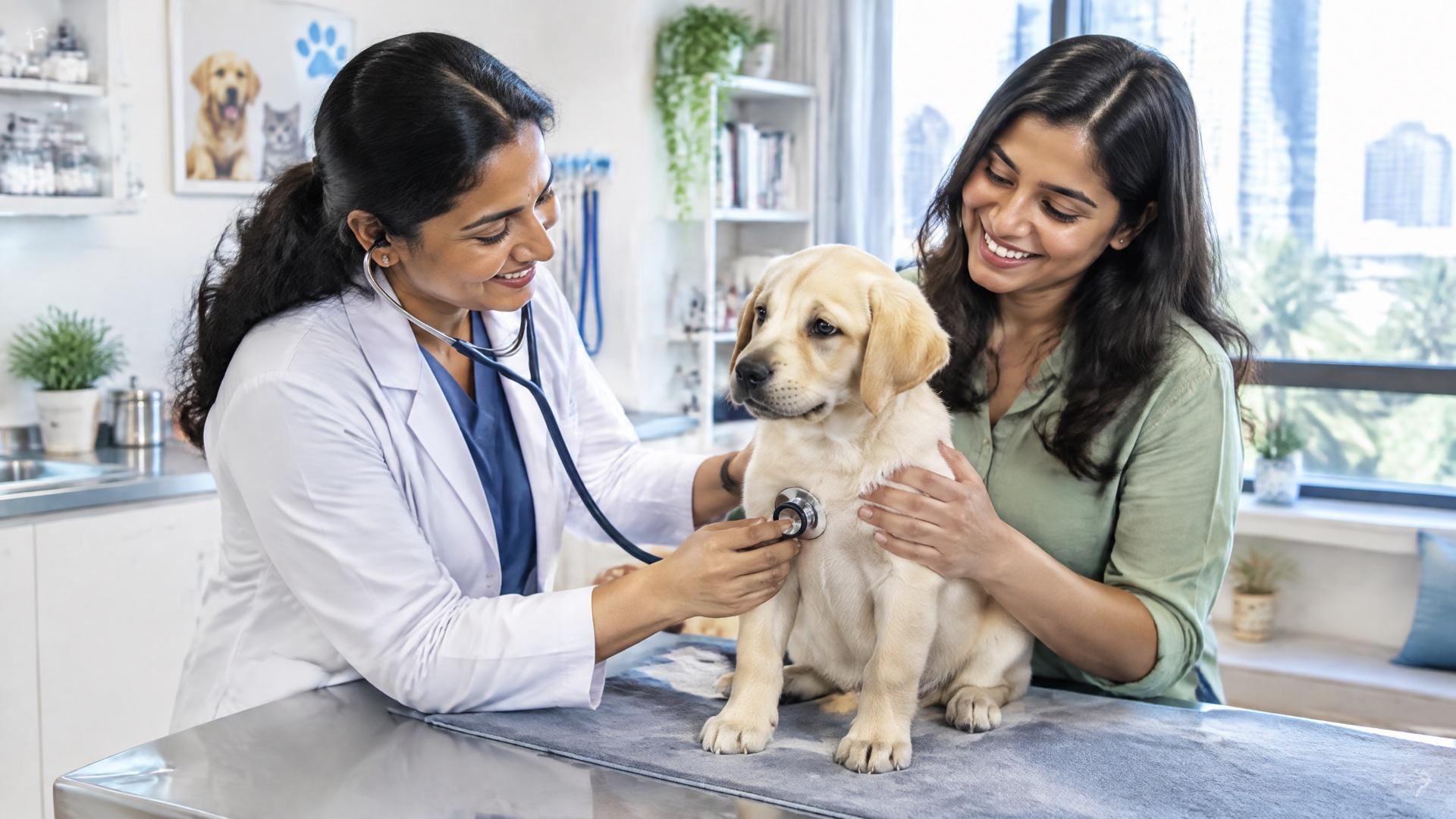
Most puppies see the vet at 6 to 8 weeks old, then every 3 to 4 weeks until about 4 months while their vaccines are given, again around 6 months to talk about neutering, and then about a year after the vaccine series for boosters and a check-up. If you have just brought a puppy home in Mumbai, Thane or Navi Mumbai, the vet's clinic will be one of its first outings. This guide answers the question "how often should a puppy go to the vet?" for the first year, explains what happens at each visit, and says when to call a vet straight away.
Key Takeaways
The first health check usually happens at 6 to 8 weeks old, and often before your puppy comes home.
VCA Animal Hospitals recommends an exam every 3 to 4 weeks from 6 to 8 weeks until 4 months of age.
Your vet sets the exact vaccine schedule, number of doses and neutering age for your puppy.
Keep your puppy off the ground in public places until your vet says its vaccines have taken effect.
How Often Should I Take My Puppy to the Vet?
In the first few months, expect a visit every 3 to 4 weeks. VCA Animal Hospitals, a US network of vet hospitals, says in its guide to caring for an 8-week-old puppy: "Between 6 to 8 weeks and 4 months of age, we recommend an examination every 3 to 4 weeks".
The AKC (American Kennel Club), a US breed registry, says in its guide on how often to take your dog to the vet: "You and your dog will likely get to know the vet pretty well in the first few months after bringing them home."
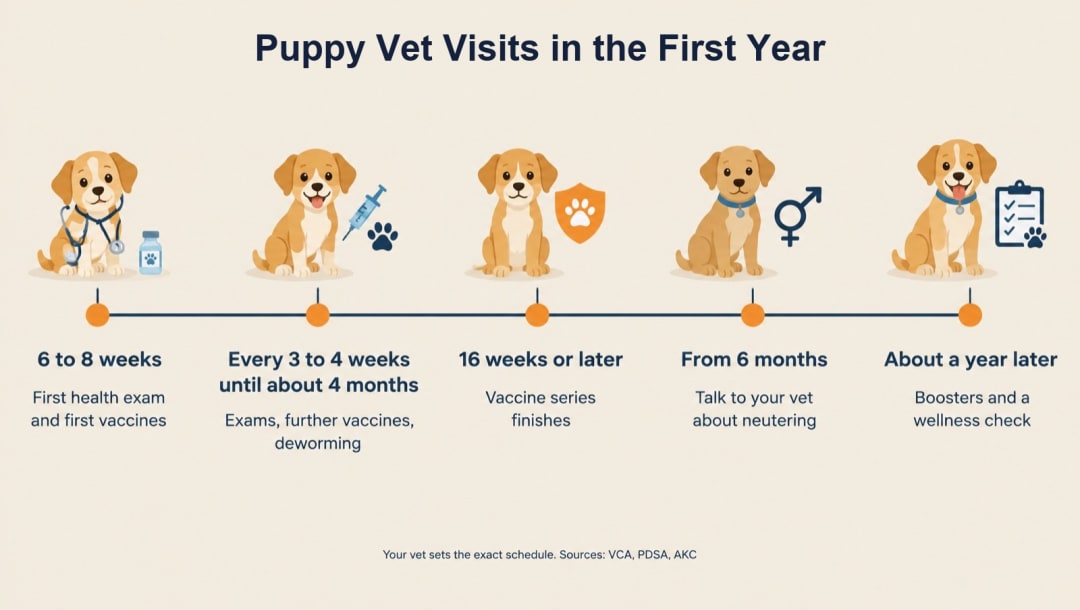
A typical first year looks like this:
6 to 8 weeks: first health exam and first vaccines.
Every 3 to 4 weeks until about 4 months: exams, further vaccines and deworming.
16 weeks or later: the vaccine series finishes.
From 6 months: a conversation about neutering.
About a year after the series: boosters and a wellness check.
When Should a Puppy Have Its First Vet Visit?
A puppy's first vet visit usually happens at 6 to 8 weeks old. VCA's guide to veterinary care recommendations for puppies says "Most puppies should visit the veterinarian at six to eight weeks of age for a health exam".
Many puppies have that first check before they reach you. The PDSA, a UK vet charity, says in its vet Q&A for new puppy owners: "Your puppy's first trip to the vet will often happen before you bring them home." It suggests you "bring your puppy's paperwork, including their vaccination and microchipping records".
Your own vet should still see your puppy. The AKC's Chief Veterinarian, Dr Jerry Klein, "recommends that a veterinarian should evaluate every newly acquired puppy." The PDSA's new puppy checklist says that once your puppy has settled in, you should "take them to the vet for a check-up and to book any remaining vaccinations".
The AKC's guide to your puppy's first vet visit notes that "Breeders generally include a veterinary examination, usually within three days, on their contracts."
What Happens at a Puppy's First Vet Visit?
The vet gives your puppy a full physical exam, checks for worms and talks you through the vaccine plan. VCA says "Your veterinarian will also perform a full physical examination," covering the skin, ears, teeth, heart, lungs and abdomen.
The AKC's first-visit guide lists weighing your puppy, taking its temperature and checking its skin, coat, teeth and abdomen. One step is to "Listen to heart and lungs with a stethoscope." Another is to "Examine feces (bring a sample) for the presence of worms (most pups have roundworms)".
Across the first-year visits, the AKC says "your vet will monitor how your puppy is growing" and "They'll also listen to the heart and lungs, check the eyes, teeth, and ears".
VCA also suggests you use visits to "talk to your veterinarian about your puppy's vaccination schedule as well as behavior and training." For training help between visits, see our guide on how long it takes to train a dog.
How Many Vet Visits Does a Puppy Need for Vaccines?
Vet sources describe two or three core vaccine visits a few weeks apart, and your vet decides the exact number for your puppy. VCA says the combined distemper, hepatitis and parvovirus shots are "given three times, spaced about three to four weeks apart." It adds: "These injections usually begin when the puppy is between six and eight weeks old, and finish at or after 16 weeks of age."
The PDSA's guide to dog vaccines differs slightly. It says "Puppies should ideally start their vaccines at around 6-8 weeks old", with two injections "2-4 weeks apart", and "Some puppies, but not all, need a third injection as part of their primary course."
Rabies is part of the plan too. VCA says "The rabies vaccine is often given at 12 to 16 weeks of age." For the full picture, read our dog and cat vaccination schedule for India.
Does My Puppy Need Deworming at Every Visit?
Deworming is a routine, repeated part of puppy wellness visits, and your vet will tell you which visits need it. VCA says "Deworming is a routine part of your puppy wellness visits" and "It is important that deworming is repeated because it only kills adult worms."
You can help by bringing a sample, since VCA notes that "You'll want to bring a fresh fecal sample to test for worms," though "Even without a stool sample, the veterinarian will use a deworming medication that's effective against the common worms".
Ask your vet about flea protection at the same visits. VCA advises: "Be sure that any flea product you use is labeled as safe for puppies." The PDSA suggests setting a diary reminder for "worming/flea treatments."
When Should a Puppy Be Neutered?
Neutering is usually discussed from around 6 months, but the right age depends on your dog. VCA says "This procedure can be done any time after your dog is six months old." The PDSA says "This is usually between 6-12 months, although this will depend on a number of factors such as their sex, breed and size."
The AKC gives a wider range, "between six and 18 months old, depending on the size and breed of your dog." For female puppies, VCA says "Spaying your dog before she experiences her first estrous cycle has several benefits." Talk through the timing with your vet.
When Can My Puppy Go Outside and Meet Other Dogs?
Your puppy can go out before its vaccines are complete, but it should be carried and kept away from unvaccinated dogs. The PDSA says puppies "will be fully protected 2-4 weeks after their final injection," and until then: "Don't allow them on the ground in public places."
This matters because the socialisation window is early. The PDSA's guide to puppy socialisation says "Between the ages of 4 weeks and 12 weeks, your puppy will have a 'socialisation period'." It also says "Your puppy shouldn't go to certain places or mix with unvaccinated dogs until they're fully covered by their vaccines."
After checking with your vet, the PDSA suggests carrying your puppy out, using gardens unvaccinated dogs don't visit, and meeting fully vaccinated older dogs.
How Often Should a Dog See the Vet After Its First Year?
Once your puppy grows up, a yearly check is the usual pattern. The AKC says "arranging an annual wellness check is still wise." Booster timing after that varies by vaccine, so your vet will set the schedule.
The first booster falls about a year after the puppy series. The PDSA says "Protection lasts 1 year – after which they'll need a booster." At that visit, ask your vet which vaccines are due and when the next boosters fall.
How to Prepare for Your Puppy's Vet Visits
Bring your puppy's records, your questions and any samples your vet asks for to every visit.
1. Book Early
The AKC suggests that "if you know exactly when you'll be picking your puppy up, call in advance to get a convenient appointment."
2. Gather the Paperwork
The AKC says "Remember to bring any paperwork, such as medical records from the breeder or rescue". That includes vaccination and microchipping records.
3. Check What Samples to Bring
Before the appointment, ask your vet "whether fresh urine or fecal samples are required", as VCA suggests.
4. Write Down Your Questions
Our advice: note down questions about feeding, behaviour and training before you go.
5. Ask About a Microchip
VCA says "A microchip is the most widely recommended form of pet identification" and that it "can be placed during any regular veterinary visit". The PDSA reminds pet parents to "keep their microchip details up-to-date throughout their lives."
Common Mistakes to Avoid
Skipping your own vet's check after the breeder's vet visit.
Missing or delaying a vaccine visit in the series.
Putting your puppy down in public places before your vet says it is protected.
Using a flea product that isn't labelled as safe for puppies.
Forgetting the booster about a year after the puppy series.
When Should You Call a Vet Straight Away?
Call your vet as soon as possible if your puppy has diarrhoea, vomiting or a fever, stops eating or seems low in energy. VCA lists these signs of parvovirus in puppies:
"Diarrhea, which is often foul-smelling, contains mucus and may contain blood"
"Vomiting"
"Lack of appetite"
"Acting depressed or having low energy"
"Fever"
For any of these, VCA advises getting your puppy seen "as soon as possible."
Can a Groomer See My Puppy Before Its Vaccines Are Done?
Not at FurDial. FurDial grooms vaccinated pets only, with up-to-date core vaccinations, so wait until your vet confirms your puppy's vaccines are up to date.
FurDial's groomers come to your home across Mumbai, Thane, Navi Mumbai and Vasai-Virar, so there is no cage and no car ride. Every groomer has 5+ years of experience. If your puppy is anxious, mention it in the booking note, and the groomer may pause or reschedule if that is safer.
Our advice: gently handle your puppy's paws, ears and face at home, with a treat each time, to help vet checks and later grooms feel more familiar. See all grooming packages and prices.
Frequently Asked Questions
What Is the 7 7 7 Rule for Puppies?
There is no vet standard for it. The 7 7 7 rule appears on pet-care websites with differing versions, but we found no vet body that defines it. For socialisation, follow your vet's advice and the PDSA's guidance above.
What Month Is Hardest With a Puppy?
No vet source we checked names a hardest month. Every puppy is different, so raise any behaviour worries with your vet at your puppy's regular visits.
Does This Schedule Apply to Kittens?
No. Kittens have their own schedule, so ask your vet to set one for your kitten.
Final Thoughts
So, how often should a puppy go to the vet? Usually at 6 to 8 weeks, every 3 to 4 weeks until about 4 months, from 6 months for a neutering talk, and about a year after the vaccine series. Call your vet straight away if your puppy falls ill.
Once your vet confirms your puppy's core vaccinations are up to date, book a FurDial groom at home.