

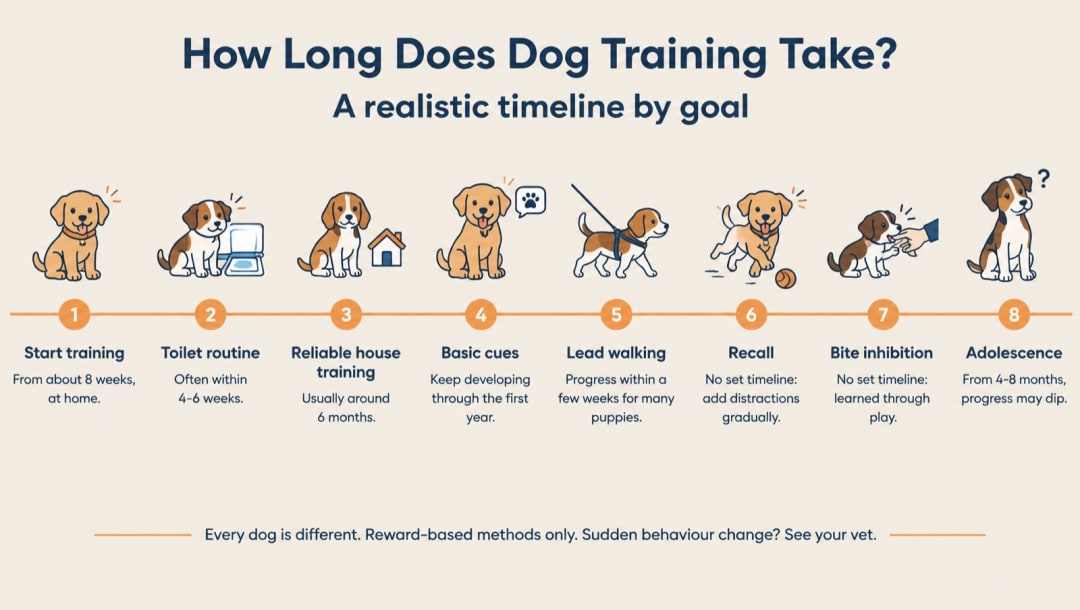
How long it takes to train a dog depends on the goal: simple cues can start the day your puppy comes home, but reliable house training takes months, and basic obedience keeps developing throughout the first year.
In a Mumbai flat, the first goals tend to be practical ones: toilet habits that work around lifts and stairs, and a dog who walks calmly along a busy road. So how long does it take to train a dog for each of these? Here's a realistic timeline by goal from vets, kennel clubs, welfare charities and researchers, plus what speeds training up.
Key Takeaways
Start training at home from about 8 weeks, with sessions of just a few minutes, a few times a day.
Most puppies settle into a toilet routine within 4-6 weeks, but true reliability usually comes at around six months.
Vet behaviour experts recommend reward-based training only. Punishment can cause fear and slow learning.
Expect progress to dip in adolescence, and take any sudden change in behaviour to your vet.
How Long Does It Take to Train a Puppy?
Expect basic obedience to keep developing throughout the first year. That's the advice in the puppy training timeline from the American Kennel Club (AKC), the US pedigree dog registry. By six months, it adds, a puppy should be making progress on house training, recall and polite play.
So at what age should dog training start? The AKC says to begin teaching basic cues when your puppy comes home, usually at about 8 weeks.
Early socialisation matters too, though sources differ on timing. VCA Animal Hospitals, a network of veterinary hospitals, says in its puppy training basics that the socialisation window falls between 7 and 14 weeks of age, while the AKC says it ends by 16 weeks.
How Long Does It Take to Potty Train a Puppy?
Anywhere from days to several months. The AKC's potty training guide says some puppies develop reliable habits within days, while others may require several months.
Battersea, a UK rescue charity, says in its toilet training guide that most puppies settle into a routine within 4-6 weeks, but that isn't full house training. True reliability, it says, usually comes later, once they're around six months old.
VCA's house training advice gives a simple test: once your puppy has gone 8-12 weeks without mistakes, they are probably ready for more freedom.
To keep things moving:
Take your puppy out every 1-2 hours when awake, as VCA suggests. Your puppy may also need night-time trips until about 5 months.
Use the AKC's rule of thumb: a young puppy can hold its bladder for about as many hours as its age in months.
If you live several floors up, allow for the lift ride when you plan toilet trips.
Never punish accidents. VCA says plainly, "Do not punish your puppy," and Dogs Trust, a UK dog welfare charity, warns in its house training advice that telling a dog off can make it anxious.
How Long Does It Take to Train a Dog to Sit?
There's no reliable week count for sit, but the first steps can be quick. VCA's vet behaviourists say that with most puppies, the food lure can be faded within 5-10 repetitions.
Keep sessions short. The AKC suggests just five to 10 minutes. The Royal Kennel Club (RKC), the UK's kennel club, recommends short sessions of five minutes several times a day in its introduction to dog training. That makes training at home realistic on busy weekdays.
How Long Does It Take to Stop a Dog Pulling on the Lead?
A few weeks to see progress in many puppies, and possibly longer for adults who have been pulling for a while. Battersea's lead walking guide says many puppies show progress within a few weeks, while adults may take longer if they've been pulling on the lead (leash) for a while. It also notes that progress often dips during adolescence.
Dogs Trust's recall advice, to add distance and distractions gradually, suits lead walking too, so start in a quiet building compound or lane before a busy road.
How Long Does It Take to Teach Recall and Stop Puppy Biting?
Neither has a set timeline, so measure progress in steps, not weeks.
For recall, Battersea's recall guide advises getting a reliable recall before adding distractions. Dogs Trust warns that getting angry or shouting will make your dog not want to come back.
For biting, the ASPCA, a US animal welfare charity, explains in its guide to puppy mouthing and nipping that puppies learn bite inhibition in play with other puppies and from people. It warns that slapping or hitting puppies for playful mouthing can cause them to bite harder.
What Is the Hardest Age to Train a Dog?
Adolescence, with one study pointing to around eight months. A Newcastle University press release on a study published in Biology Letters found dogs were harder to train at eight months and more likely to ignore commands. The researchers advise against punishment and say the phase will pass.
Sources disagree on when adolescence starts. The RKC's guide to the teenage years says it can begin anywhere between 4 and 8 months and last from a few days to a couple of months. Your puppy may act as if it hasn't heard you, and the RKC suggests using a long line.
Dogs Trust Ireland, the charity's Irish arm, defines adolescence more broadly, as 6-24 months. It reports that 49 per cent of 2,713 surrender requests in 2023 were for adolescent dogs.
What Is the Fastest Way to Train a Dog?
Short, frequent sessions using rewards. The American Veterinary Society of Animal Behavior (AVSAB) recommends in its position statements that "only reward-based training methods be used for all aspects of dog training". Writing for AVSAB, Zazie Todd PhD notes there is no evidence that aversive methods are more effective than reward-based methods in any context.
The research points the same way:
A 2020 PLOS ONE study of 92 dogs found that dogs trained with aversive methods showed more stress behaviours, higher cortisol rises and more "pessimistic" responses. This shows an association, not proof of cause.
A 2020 Frontiers in Veterinary Science study of 63 dogs found that the reward-focused group responded significantly better to "Sit" and "Come".
The PDSA, a UK vet charity, says in its reward-based training guide that punishments "cause anxiety and fear; which are proven to make animals learn slower".
How to Train Your Dog at Home, Step by Step
1. Start on Day One
Begin a toilet routine and one or two simple cues, such as sit, in sessions of a few minutes, a few times a day, as VCA suggests.
2. Reward the Behaviour You Want
Reward the moment it happens with a treat or praise. VCA calls rewards best practice and warns that punishment can lead to "avoidance, fear, and confusion".
3. Fade the Food Lure
Once your puppy follows the treat reliably, start fading the food lure.
4. Add Distance, Distractions and New Places Slowly
Practise in a quiet room first, then the corridor, the compound and finally the street.
5. Plan for the Teenage Dip
When your dog seems to forget everything, go back a step, use a long line for recall as the RKC suggests, and stay patient.
Common Mistakes to Avoid
Expecting a fixed finish date.
Telling your puppy off for toilet accidents.
Slapping or hitting your puppy for mouthing.
Adding distractions or off-lead time before recall is reliable.
Shouting when your dog is slow to come back.
Assuming a sudden change in behaviour is just stubbornness.
When Should You Call a Trainer, a Vet or a Behaviourist?
Start with your vet whenever behaviour changes. Dogs Trust's guide to finding behaviour and training support says, "The first step is always to speak to your vet," because a change in behaviour could be a sign your dog is unwell or in pain.
Pain can sit behind behaviour problems. A 2020 review of 100 dog cases by Mills and colleagues, published in Animals, gave "a conservative estimate of around a third of referred cases" involving some form of painful condition.
See your vet first if your dog:
changes behaviour suddenly
shows aggression
starts having accidents indoors after being house trained
seems distressed when left alone, with barking, howling, toileting indoors, destructiveness, trembling, pacing or whining
The RSPCA, a UK animal welfare charity, lists those separation signs in its guide to training your dog to be left alone, and warns that problems get worse when owners punish.
Ask your vet about a behaviourist for aggression, separation distress or problems that don't improve. The RSPCA's page on how to find a clinical animal behaviourist warns that outdated methods can make behaviour worse, and Dogs Trust cautions that "anyone can call themselves a 'behaviourist'", so check qualifications.
Call a trainer for everyday goals: toilet routines, sit and stay, lead walking and recall. If you're looking for a dog trainer in Mumbai, ask how they train and choose one who uses rewards only.
How Much Does Dog Training at Home Cost?
FurDial's at-home dog training costs ₹14,999 a month (shown reduced from ₹17,999) for 12 sessions with a FurDial trainer at your home. You pay month by month, before each month starts, and you can stop after any paid month, with no lock-in.
Every program costs the same each month:
Sit & Stay, 2 months: potty training and bite inhibition; sit, stay, down and head down; public settings and traffic safety; leash walking and heelwork; reliable recall and sit-stay; handshake and high-five tricks.
The Level Up, 4 to 6 months (most popular): everything in Sit & Stay, plus no-command, jump and bark control; rest, sleep, roll, spin, hold it, drop it; retrieval and basic scent work; separation anxiety and travel guidance; nutrition, coat care and vaccine advice.
The Full Command, 18 months: everything in The Level Up, plus elite scent and detection work, personal protection and territory guarding, distance control and send away/place, crawling and precision speak/quiet, and full agility and obstacle course training.
A person calls you back first to recommend a program, so nothing is bought from a dropdown. Your dog keeps its own trainer, and each visit is logged with a code sent to your phone.
A program's length is a plan, not a guarantee: house training and recall can keep developing for months, and progress may dip in adolescence. A trainer is not a vet, so take any sudden behaviour change, aggression or separation distress to your vet first.
FurDial also grooms dogs and cats at home; see how an at-home groom works.
Frequently Asked Questions
Can a Dog Be Trained in 2 Weeks?
Not fully. No source we checked gives a two-week timeline. Two weeks is enough to start basic cues and a toilet routine, but reliable house training, recall and good behaviour through adolescence take months.
What Is the 3-3-3 Rule for Dog Training?
It's a rough guide for rescue dogs settling in, not a training schedule. The AKC's questions to ask when rescuing a dog describes 3 days to decompress, 3 weeks to learn routines and feel safe, and 3 months to bond and settle. It notes that this can be shorter or longer.
Can Old Dogs Learn New Tricks?
Yes. The PDSA says "old dogs can learn new tricks, too!", and the RKC says training can happen at any age. The AKC's guide to training your senior dog adds that older dogs may respond more slowly, so get your vet's all-clear first.
How Long Does It Take to House Train an Adult Dog?
It depends on the dog's history. Battersea says a previously house trained adult may need about a week. Dogs Trust says puppies might take a few months to be completely house trained, and adults that were never house trained may also take longer.
Final Thoughts
So how long does it take to train a dog? Think in months, not weeks: basic obedience develops over the first year. Keep sessions short, reward what you want, expect a teenage dip, and take any sudden change in behaviour to your vet.
If you'd like a trainer to come to you, see FurDial's at-home dog training programs and someone will call you back to recommend the right one.