
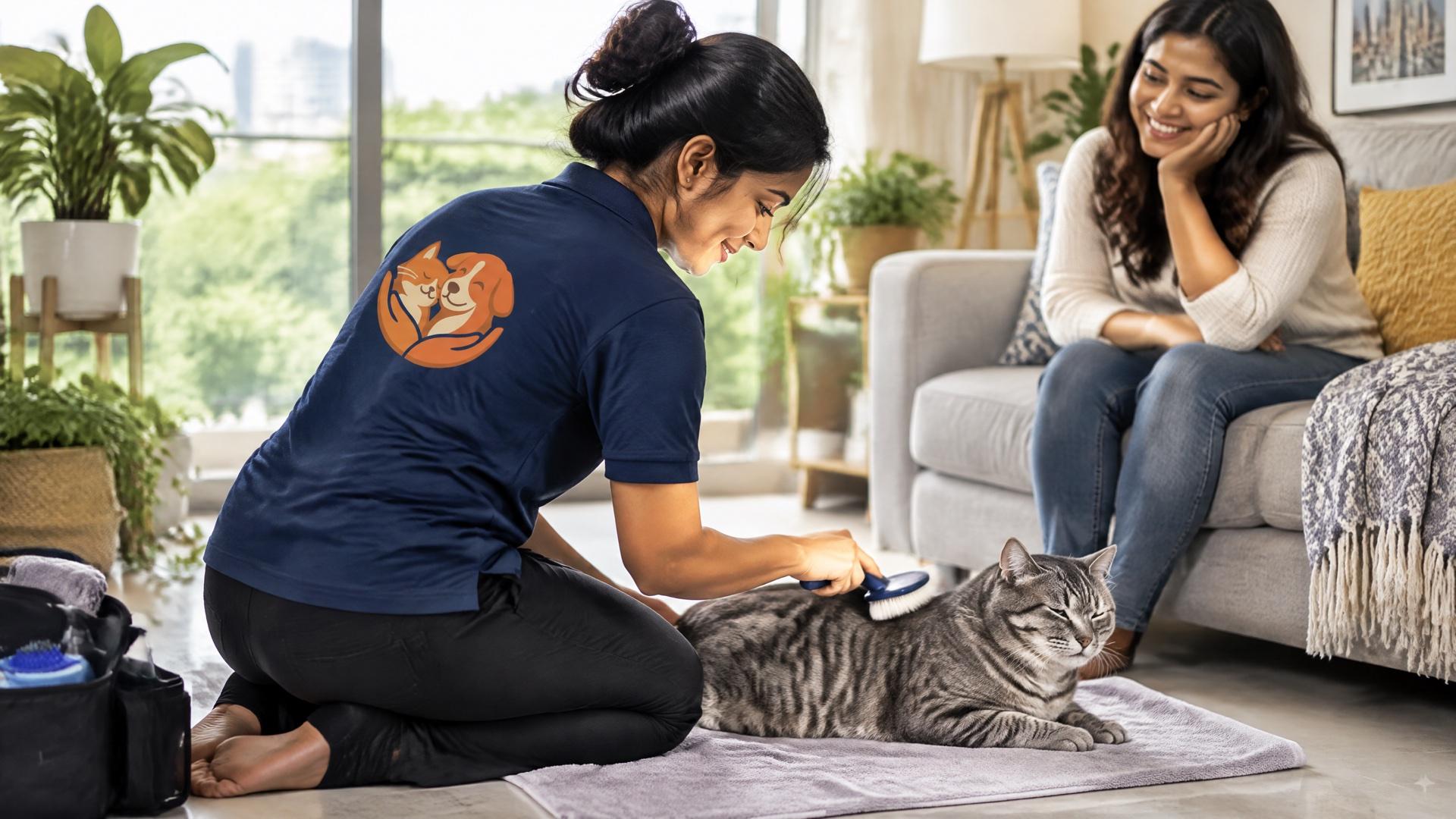
Brush a short-haired cat at least once a week and a long-haired cat every day, bathe only when there's a real need, and check claws, ears and teeth regularly. Kittens need gentle practice, and older or overweight cats often need extra help. In Mumbai, the monsoon adds one more job: drying damp fur properly. Here's a practical answer to "how often should a cat be groomed?", by coat type, age and task, plus the changes that mean it's time to see your vet.
Key Takeaways
Brush short-haired cats at least once a week and most long-haired cats daily, for as long as your cat is comfortable.
Healthy cats rarely need a bath. If one is needed, use cat shampoo and dry the coat fully.
Experts disagree on claw trims, so check claws regularly and older cats' paws weekly.
A cat that suddenly grooms much more or much less needs a vet, not a groomer.
How Often Should a Cat Be Groomed?
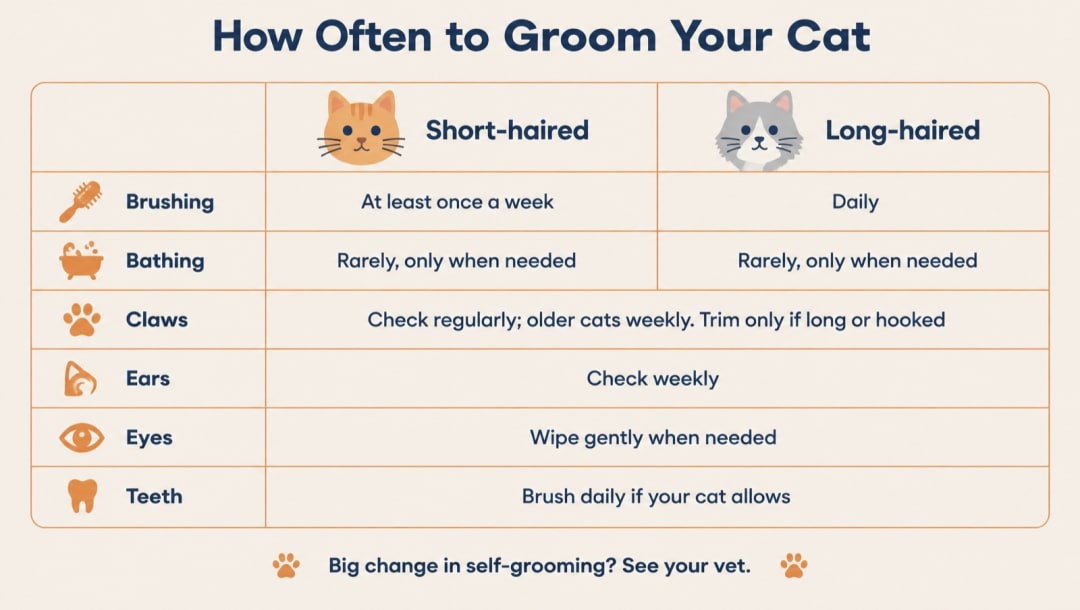
Every cat needs some grooming each week, and long-haired cats need it daily. The schedule by task:
Brushing: at least once a week for short-haired cats, daily for most long-haired cats.
Bathing: rarely, only when the coat genuinely needs it.
Nails: check regularly, and weekly for older cats. Trim only if they're long or hooked.
Ears: check once a week.
Eyes: wipe gently when needed, with a fresh damp cotton ball for each eye.
Teeth: brush daily, if your cat will accept it.
How Often Should You Brush a Cat?
At least once a week for short coats, and daily for long ones. The RSPCA, a UK animal welfare charity, says in its guide to grooming your cat that short-haired cats "do a good job of grooming themselves" but still need grooming sessions at least once a week.
Some suggest more. The ASPCA, a US animal welfare charity, suggests one or two brushings a week, and the PDSA, a UK vet charity, suggests a few times a week for breeds such as the Siamese. Once a week is the shared minimum. For example, a short-haired cat needs at least a weekly brush and regular claw checks, while a Persian needs a daily comb.
Long coats need daily care. International Cat Care, a feline welfare charity, says in its cat grooming guide that "Longhaired cats need to be groomed at least daily but only do this for as long as your cat is comfortable." The PDSA lists the Birman, Persian and Ragdoll for daily brushing (for Persians, see our guide to Persian cat grooming at home).
The PDSA warns: "Armpits, legs, tummy, and tail are danger zones for matting." The ASPCA adds that "Matted hair can be painful and lead to underlying skin problems."
Brushing helps with hairballs too. The Cornell Feline Health Center, part of Cornell University's vet college, recommends brushing and combing daily and notes that long-haired breeds are at greater risk.
How Often Should a Cat Be Bathed?
Rarely. International Cat Care says, "If your cat is healthy there is no reason to bath your cat." VCA Animal Hospitals, a network of vet hospitals, agrees that "Most healthy adult cats are fastidious groomers and rarely require a bath."
There are exceptions. VCA says arthritic, overweight or allergic cats may need occasional baths, and the ASPCA suggests one if your cat gets "very dirty or gets into something sticky or smelly." The PDSA notes that hairless breeds such as the Sphynx may need a gentle cat-shampoo bath as often as weekly.
If a bath is needed:
Brush out tangles first, as VCA advises.
Use cat shampoo, one part to five parts lukewarm water, as the ASPCA suggests. It warns that human shampoo "can dry out her skin."
Towel-dry in a warm place, or use a dryer on the "lowest heat setting", as the ASPCA advises.
Flaky or itchy skin? See your vet, and read our guide to dry, itchy skin in dogs and cats.
How Does Mumbai's Monsoon Change Cat Grooming?
It makes drying more important. A 2015 study from Kolkata, published in the journal Veterinary World, found that fungal skin infections (dermatophytes, which cause ringworm) in dogs and cats "were more prevalent in the rainy seasons". The researchers linked this to India's "warm and humid climate".
The study doesn't show that a damp coat causes infection, but it's a reason for care. So whenever your cat gets wet, towel-dry it in a warm place, as you would after a bath, until the coat is fully dry.
VCA's guide to healthy coat and skin says healthy skin is "not greasy, flaky, or bumpy", and the RSPCA advises that if the coat's condition changes, "visit your vet".
How Often Should You Trim a Cat's Nails?
Anywhere from every ten days to every four weeks, if at all, because the experts disagree. The ASPCA suggests trimming every ten days to two weeks, while VCA's guide to handling exercises for nail trims says most cats need trims every two to four weeks.
International Cat Care's guide to trimming your cat's claws takes the opposite view: "Routine trimming of a cat's claws isn't advisable." The PDSA agrees that "Healthy, young cats shouldn't need their nails clipping".
A sensible middle ground is to look at the claws every couple of weeks and trim only if they're long or hooked. International Cat Care warns that older, arthritic cats may get overgrown claws that grow into their pads, and the PDSA suggests checking senior or less mobile cats' paws weekly.
If you do trim, ask your vet to show you first, as International Cat Care recommends. Snip only the clear tip and avoid the quick. At first, the ASPCA suggests trimming no more than two claws in one sitting.
How Often Should You Check Your Cat's Ears, Eyes and Teeth?
Ears weekly, eyes when needed, and teeth daily if your cat allows it.
Ears: the ASPCA suggests checking them once a week and warns, "do not attempt to clean the canal." The PDSA says waxy, smelly or itchy ears need a vet check before any cleaning.
Eyes: the ASPCA suggests wiping away from the corner of the eye.
Teeth: the PDSA says "cats' teeth need brushing daily". The Cornell Feline Health Center's page on feline dental disease says "Daily toothbrushing can prevent most forms of dental disease" and that "human toothpaste is not safe for cats".
Cornell lists drooling, bad breath and reluctance to eat as signs of dental disease. See your vet if you spot any.
Do Kittens, Older and Overweight Cats Need a Different Schedule?
Yes. Kittens need short, gentle practice, while older and overweight cats usually need more help.
Kittens
International Cat Care advises getting kittens "used to being groomed from an early age" and building tolerance gradually, and says a cat should "never be forcibly groomed". The PDSA suggests treats and praise.
Older and Overweight Cats
The PDSA says older cats may need more brushing, and International Cat Care's guide to senior cats says they "often struggle with maintaining their usual grooming routine", with mats over the lower spine and hindquarters. PetMD, a pet health site, says arthritis "makes the motion of grooming painful". VCA adds that obesity can also cause matting or dandruff.
How Often Is It Normal for a Cat to Groom Itself?
Often. The PDSA's vet Q&A on grooming too much says it's "normal to see your feline friend preening themselves throughout the day". What matters is a change.
Signs of Overgrooming
International Cat Care's guide to over-grooming in cats says it usually shows on the belly, inner hind legs and flanks. Causes include flea allergy, pain and stress, and it advises contacting your vet "as soon as possible".
Signs of Undergrooming
International Cat Care says "Decreased grooming behaviours may indicate chronic (long-term) pain from arthritis or dental disease." Its guide to arthritis in cats lists "Less time spent grooming" and a "Matted and scruffy coat" as signs. PetMD adds that kidney disease, thyroid disorders and diabetes "can also cause decreased grooming".
Common Mistakes to Avoid
Assuming a short-haired or indoor cat needs no grooming.
Using human shampoo or human toothpaste.
Cutting out mats with scissors. VCA says "never scissors".
Leaving fur damp after a bath or a wet monsoon day.
Carrying on when your cat says stop. The RSPCA suggests ending the session if your cat is "twitching, swishing their tail, growling or hissing".
When Should You Call a Groomer or a Vet?
Call a groomer for coat care you can't manage at home, and your vet first for anything that looks like a health problem.
Call a groomer when:
tangles won't brush out at home but the skin underneath looks healthy (VCA suggests professional help for severe tangles)
your long-haired cat needs a bath and full dry you can't manage
the coat needs a trim or a sanitary tidy-up
Call a vet when:
mats are tight to the skin or the skin under them is sore. International Cat Care says severe matting may need the vet team, sometimes under sedation.
your cat is overgrooming, losing hair or has stopped grooming
the skin is greasy, flaky or bumpy, or the ears are waxy, smelly or itchy
you notice drooling, bad breath or reluctance to eat
your cat vomits more than once or twice a month, which VCA says is not normal "even if it's only hairballs"
How Much Does Cat Grooming at Home Cost in Mumbai?
FurDial's at-home cat grooming costs ₹1,199 (The Glow Up, about 45 minutes) or ₹1,799 (Snip & Purr, about 60 minutes), GST included, with no travel charge. A groomer comes to your home anywhere in the areas we cover across Mumbai, Thane, Navi Mumbai and Vasai-Virar. There's no cage and no car ride, and you can pay after the service by UPI or cash, or pay online.
The Glow Up, ₹1,199: a dry bath with waterless shampoo or foam (no water or dryer), plus ear, eye and paw cleaning. Nail clipping is included, and a full body haircut, trim or zero cut can be added at booking.
Snip & Purr, ₹1,799: a bath with shampoo for sensitive feline skin, a calm blow dry, a full body haircut (zero cut, trim or styled finish, agreed before starting), ear, eye and paw cleaning, deep combing to clear tangles and loose fur, nail clipping and sanitary cutting.
The Glow Up suits short-haired cats that need ear, eye and paw cleaning or a nail trim without water. Snip & Purr suits long-haired cats with tangles, and cats who genuinely need a bath, such as arthritic, overweight or soiled cats, because it adds deep combing and a calm blow dry.
Every groomer has 5+ years of experience. Only pets with up-to-date core vaccinations can be groomed, and heavy matting may carry a small surcharge, told on arrival before starting. If your cat is anxious, mention it in the booking note. See all grooming packages and prices and what pet grooming costs in Mumbai.
Frequently Asked Questions
Do Indoor Cats Need to Be Groomed?
Yes. The ASPCA says "Long-haired cats who live indoors shed throughout the year and need grooming sessions every few days." Most other sources say daily. Short-haired indoor cats still need brushing at least once a week.
What Happens If You Don't Groom Your Cat?
Long coats can mat, and as the ASPCA warns, mats can be painful and lead to skin problems.
How Often Should I Take My Cat to the Groomer?
No fixed interval suits every cat. Book a professional groom when tangles won't brush out, your cat needs a bath you can't manage, or an older cat can't keep its coat tidy.
Final Thoughts
Brush weekly or daily depending on the coat, and bathe rarely. Check claws, ears and teeth regularly, dry damp fur well in the monsoon, and take any big change in self-grooming to your vet.
If you'd like help with brushing, baths or tangles, book a FurDial groom at home and a groomer will come to you.