
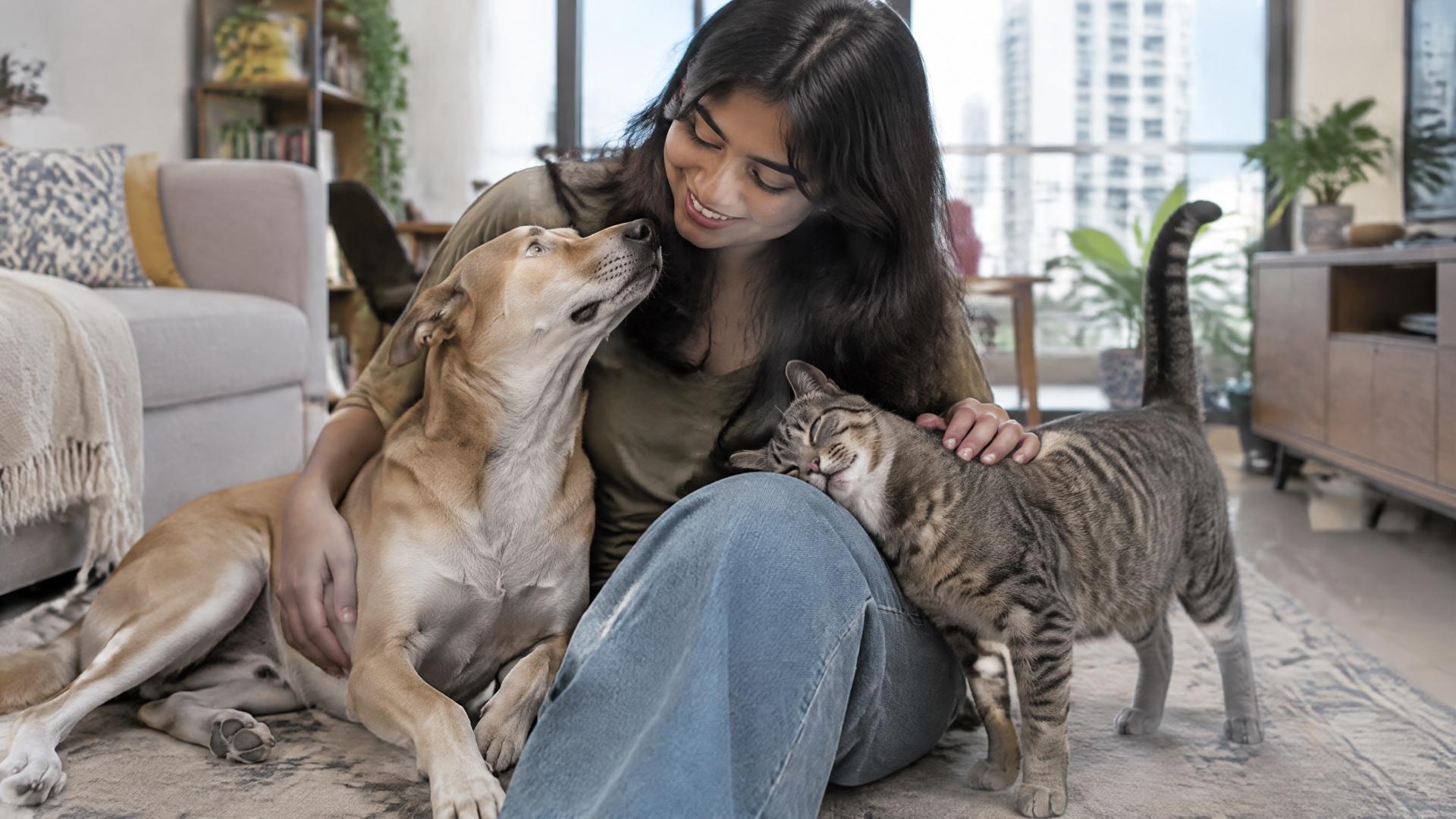
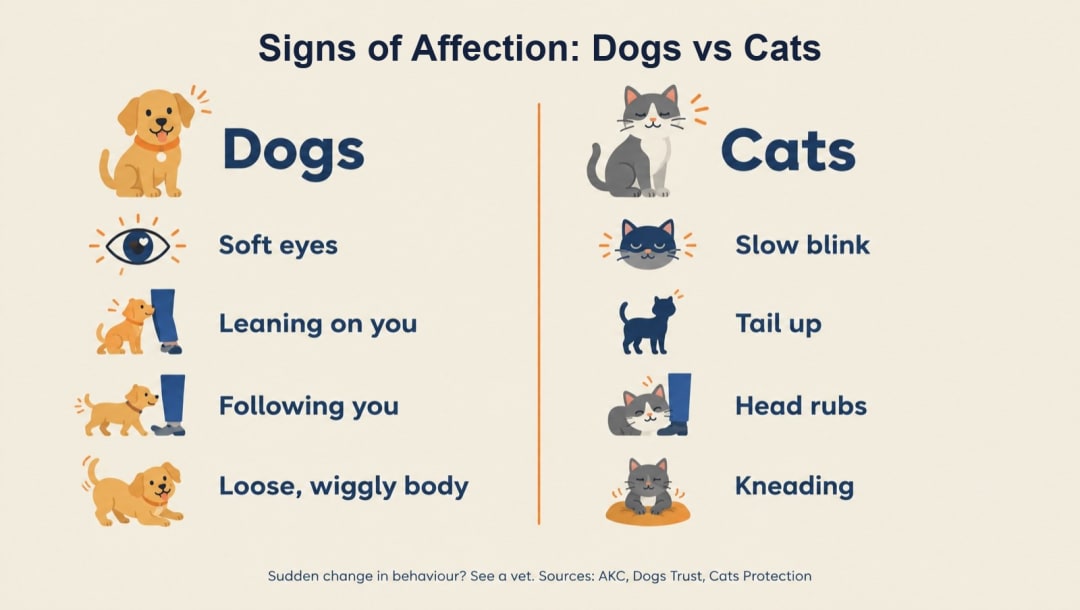
Signs your dog loves you can include soft eyes, leaning on you or sitting on your feet, following you from room to room and a loose, wiggly body; a cat may show it with slow blinks, a raised tail, head rubs and kneading. In a busy Mumbai home, these quiet moments are easy to miss. This guide explains the signs your dog loves you, how to tell if your cat loves you, and when a sudden change in affection is a reason to see a vet.
Key Takeaways
Soft eye contact, leaning on you and following you around can all be signs of a dog's affection.
A slow blink, a tail held upright and head rubs are some of the ways a cat shows it likes you.
Read the whole body, not one part: a wagging tail does not always mean a happy dog.
Sudden clinginess, heavy licking or a change in behaviour can point to stress or pain, so see a vet.
How Can You Tell If Your Dog Really Loves You?
Your dog's affection can show in relaxed body language and in how they seek you out: soft eyes, leaning on you, following you and a loose, relaxed body.
Soft Eye Contact
A gentle, relaxed gaze can be a sign of love. The American Kennel Club (AKC), a US dog breed registry, says in its guide to why your dog stares at you that "a lot of dog staring is exactly what it seems", calling it "an expression of love".
The AKC's article on how to know if your dog is happy describes the look: "They kind of soften their eyes and their ears are back just a little."
A hard stare is different. The AKC warns: "If a dog gives you a hard stare, with unblinking eyes and a stiff posture, back away and don't make eye contact."
Leaning on You or Sitting on Your Feet
A dog that leans against you or sits on your feet may be asking to be close. Dr Mary Burch, quoted in the AKC's piece on why dogs sit on your feet, says "Often when dogs sit on our feet, it's because they want to be close to us". The article adds: "Think of your dog sitting on your feet as the canine version of a hug or cuddle."
The same article notes that "Separation anxiety can prompt sitting and seeking reassurance", so this sign is worth reading alongside the rest of your dog's behaviour.
Following You Around
Some dogs like to be wherever you are. According to the AKC's guide to dogs that follow you everywhere, these dogs are often called Velcro dogs because of "their desire to be attached to your side."
A Loose, Wiggly Body
A relaxed body is a good sign your dog feels at ease. Dogs Trust, a UK dog welfare charity, explains in its guide to reading a dog's body language that in a relaxed dog "The tail and body are likely to move loosely and could appear 'wiggly'."
Licking
Licking can be a sign of affection, but not always. AKC experts say in the article why your dog licks you that "Licking can be a sign of affection" and it "might also give a dog a feeling of security and comfort."
Do Dogs Actually Love Their Owners?
Research suggests the bond between dogs and their people is real and shows up in the body. The AKC says "mutual staring between humans and dogs releases oxytocin, known as the love hormone."
A 2015 study by Nagasawa and colleagues in the journal Science found that "gazing behaviors from dogs, but not from wolves, increased oxytocin concentrations in owners", as summarised in a commentary on the dog gaze and oxytocin study in Frontiers in Psychology, a peer-reviewed journal. The commentary calls the study's idea that this loop evolved during domestication "premature", so treat it as one finding.
Do Dogs Like Sleeping With Humans?
Sharing your bed is likely to delight a well-adjusted dog, and it can strengthen your bond. The AKC's guide on whether your dog should sleep with you says that for a well-adjusted dog, bed-sharing is unlikely to do "anything except delight your dog, comfort you, and enhance the dog-owner bond".
There are downsides to weigh up. The AKC notes that "Human allergies can be aggravated" and "Quality of sleep can also be affected."
How Do I Say "I Love You" to My Dog?
You say "I love you" to your dog through routine, gentle handling, play and time together. The AKC explains in its guide to showing your dog you love them: "Predictable routines, gentle handling, and time spent together help build trust and reinforce your bond."
Give them a varied day: "A full, enriched life includes opportunities to sniff, run, play, and investigate."
Learn what they value: "One dog may thrive on treats, while another prefers toys."
Go at their pace: "Paying attention to your dog's comfort level helps you provide affection in a way they enjoy."
If you are new to all this, our first-time pet parent guide covers the basics of settling in.
How Can You Tell If Your Cat Loves You?
Your cat may be showing love if they slow blink at you, walk up with their tail held high, rub their head on you or knead on your lap. Cats Protection, a UK cat charity, lists these signs in its article on five signs your cat loves you.
The Slow Blink
A slow, sleepy blink is a sign of trust. Cats Protection says "This is a good sign that they like you a lot", and "It means they trust you enough that they don't need to keep a watchful eye on you at all times."
Tail Held Upright
"If your cat comes towards you with their tail pointing upwards, then it means they are happy to see you," according to Cats Protection. International Cat Care (iCatCare), an international cat welfare charity, agrees in its guide to how cats communicate that a raised tail "signals friendly intent when a cat approaches another cat, animal or person."
Head and Cheek Rubs
A cat that bumps its head against you is sharing its scent. Cats Protection explains: "When a cat rubs their head or cheek on you, they're actually transferring some of their own scent."
Kneading
Kneading may be a sign your cat feels content. On kneading, Cats Protection writes: "It's thought they do this because it feels good and is a sign of contentment."
How Do I Say "I Love You" in Cat?
You can say "I love you" in cat by slow blinking back. Cats Protection suggests returning a slow blink when your cat gives you one.
Research points the same way. A 2020 study in Scientific Reports, the cat slow blink study by researchers at the Universities of Sussex and Portsmouth, found that cats narrowed their eyes more when their owners slow blinked at them. Cats were also more likely to approach an unfamiliar person after a slow blink than after a neutral face. The researchers say slow blinks may be a form of positive emotional communication between cats and humans.
Be patient. Cats Protection reminds pet parents that "Each cat is an individual" and "Some cats take longer than others to build a relationship".
Are Cats Loyal to Their Owners?
Research suggests cats do bond with their people, much as children and dogs do. In a news story on cats forming attachments to their caregivers, Oregon State University, a US public university, reports that a 2019 study in the journal Current Biology found "pet cats form attachments with their human owners that are similar to the bonds formed by children and dogs."
Among kittens, "64.3% were categorized as securely attached", and adult cats showed "65.8% secure and 34.2% insecure." The story adds that "the majority of cats use humans as a source of comfort".
Common Mistakes to Avoid
These five mistakes can lead you to misread your pet.
Judging by the tail alone: Dogs Trust says "Only looking at one part of the body won't fully explain how they feel."
Taking a hard, stiff stare as love.
Forcing cuddles on a dog or cat that is not in the mood.
Assuming a slow-to-warm-up cat does not like you.
Ignoring a sudden change, such as new clinginess or constant licking.
For the signs of fear and stress, see our guide to calming an anxious dog or cat.
When Should You See a Vet About a Change in Affection?
See a vet if your pet's behaviour changes suddenly, such as new clinginess, heavy licking or purring while tense. Some signs that look like love can also mean stress or pain.
Dr Jerry Klein, quoted in the AKC's guide to Velcro dogs, says "A dog that suddenly becomes very clingy may be suffering from a physical ailment" and "A checkup by the veterinarian is a good idea if this happens". With licking, the AKC warns that if it is excessive, "this might be a sign of anxiety, boredom, or pain", and advises you "start by having your veterinarian check them out".
See a vet if your pet:
suddenly becomes clingy or follows you anxiously
licks you excessively
purrs while tense or seems to be in pain
seems to panic when left alone
Can At-Home Grooming Be Calm Time With Your Pet?
Yes, at-home grooming means the groomer comes to your home, so there is no cage and no car ride. FurDial covers Mumbai, Thane, Navi Mumbai and Vasai-Virar, and every groomer has 5+ years of experience.
For dogs, The Clean Aesthetic (₹1,699, about 90 minutes) includes a bath, blow dry, brush out and nail clipping. For cats, The Glow Up (₹1,199, about 45 minutes) is a dry bath with no water or dryer, plus ear, eye and paw cleaning. If your pet is anxious, mention it in the booking note; the groomer may pause or reschedule if that is safer. Prices include GST, with no travel charge, and only pets with up-to-date core vaccinations can be groomed. See every grooming package and price.
Frequently Asked Questions
Does a Wagging Tail Always Mean a Dog Is Happy?
No. Dogs Trust says "While dogs do wag their tails when they're happy and relaxed, they also wag them for other reasons too." Look at the face and body as well.
Why Does My Cat Show Me Their Tummy?
It can be a greeting. Cats Protection says "If your cat rolls over and shows you their tummy, it's a way of greeting you." It also warns that touching the tummy may get you scratched.
Does Purring Mean a Cat Loves You?
Not on its own. In its guide to cat body language, Cats Protection says that thinking a purring cat is happy "is only true if their body language is relaxed", and that "Sometimes cats can purr in stressful situations, such as going to the vet." Cats "can also sometimes purr if they are in pain."
Final Thoughts
The signs your dog loves you include soft eyes, leaning and following you; cats slow blink, raise their tail and rub against you. Love them back with routine, play and gentle handling, and see a vet if affection suddenly changes.
When grooming time comes round, keep it calm and close to home: book a FurDial groom at home.