
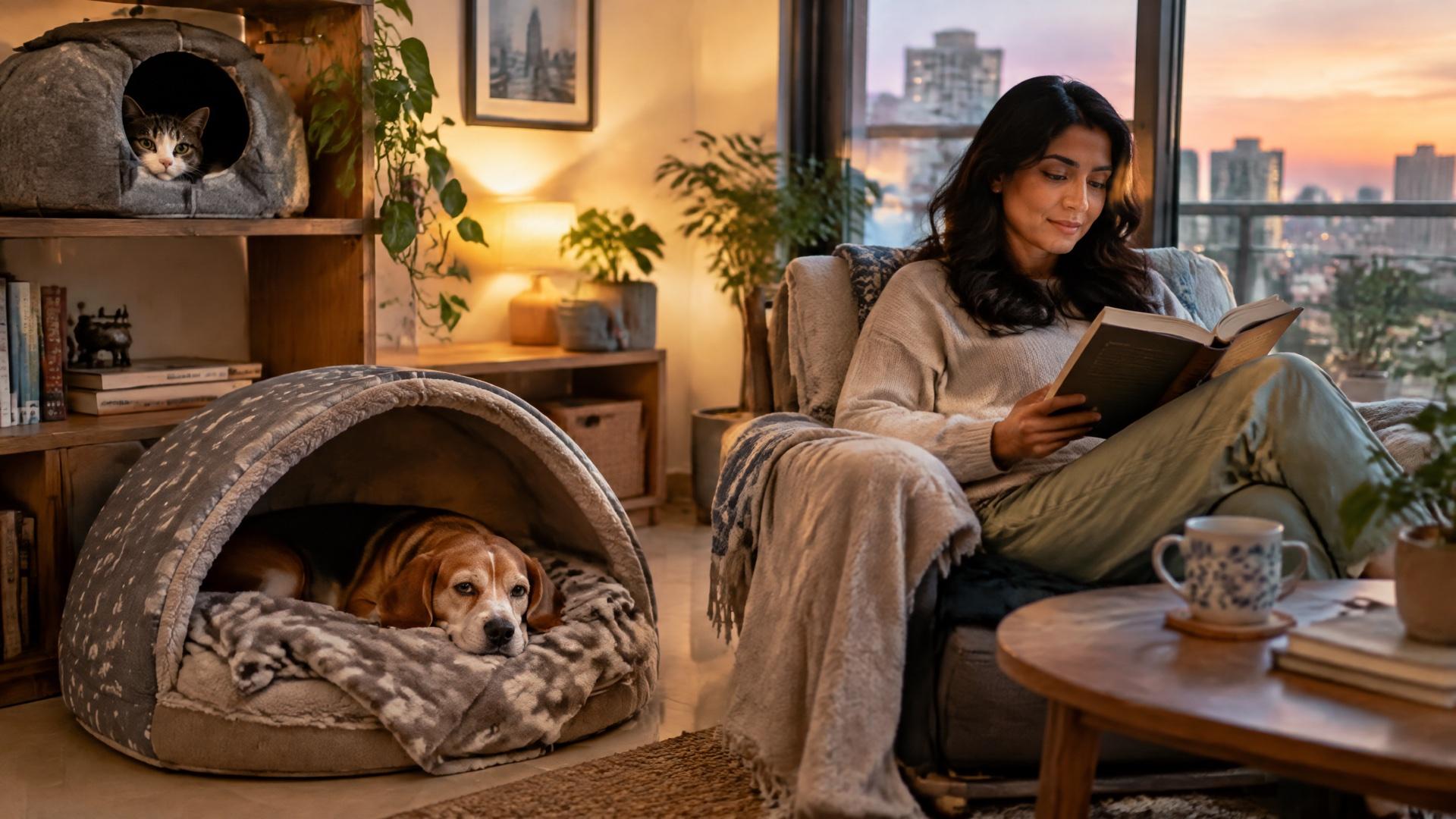
To calm an anxious dog or cat, give them a safe space they can always reach, keep a predictable daily routine, meet their exercise and play needs, use gentle reward-based training, and never punish fear; if the anxiety is new or severe, see your vet first. For pet parents in a Mumbai flat, construction noise, doorbells, visitors and traffic can all unsettle a nervous pet. This guide explains how to calm an anxious dog at home, how to help an anxious cat, and when to get professional help.
Key Takeaways
Early signs of anxiety can be subtle and easy to miss, such as lip licking, yawning, hiding or flattened ears.
A den or hiding place your pet can always reach, but is never shut inside, helps them feel safe.
Comforting a scared pet is fine, but punishing or telling them off makes fear worse.
Sudden fear can point to pain or illness, so book a vet check before anything else.
How Can You Tell If a Dog Has Anxiety?
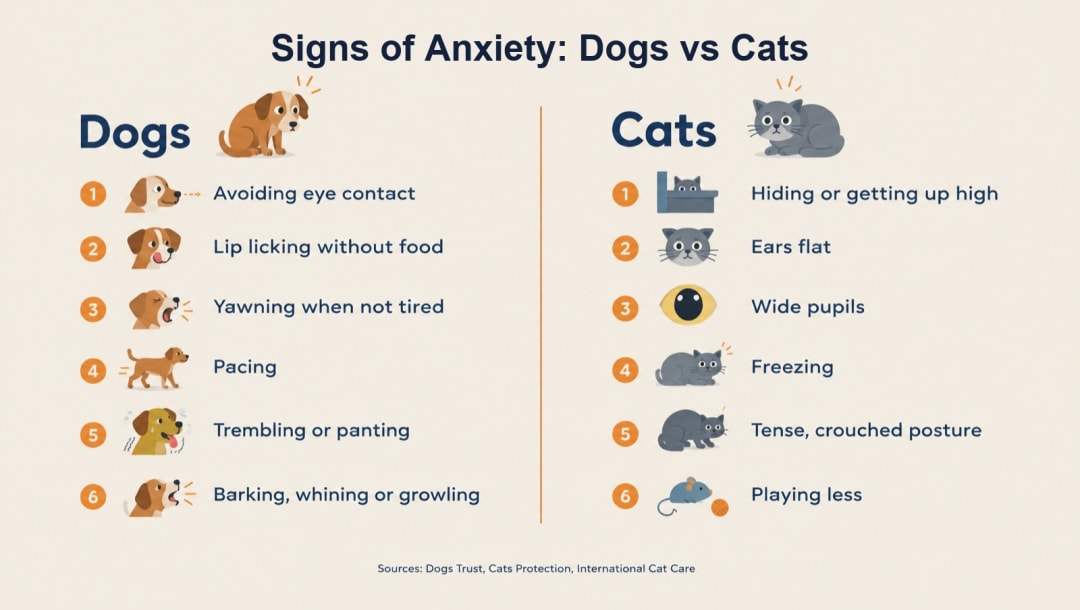
You can tell a dog has anxiety from body language such as pacing, trembling, lip licking, yawning and avoiding eye contact. Dogs Trust, a UK dog welfare charity, lists the signs in its guide to reading your dog's body language, including:
"avoiding touch or eye contact"
"moving away or hiding from what worries them"
"barking, whining or growling"
pacing, or seeming restless or unsettled
"shaking, trembling (without feeling cold) and panting (without feeling warm)"
yawning when not tired, lip licking without food, and a tucked tail
Dogs Trust warns that "Initial signs of anxiety or stress can be subtle and happen quickly which makes them easy to miss." If these signs aren't noticed, it says a dog "may feel the need to 'shout' their concerns", so the quiet signals matter.
What Are the Signs of Anxiety in Cats?
The signs of anxiety in cats include hiding, getting up high, flattened ears, wide pupils and playing less. International Cat Care (iCatCare), an international cat welfare charity, says in its guide to stress in cats that "Cats don't tend to show their emotions as overtly as other species do".
Cats Protection, a UK cat charity, explains in its guide to cat body language that a stressed cat "may try to hide or get up high", and that its "Ears are flat" with "Eyes open with wide pupils".
iCatCare lists "Freezing", a "Tense posture and muscles, often crouched down", "Hiding" and "Playing less" among the signs, plus changes in eating, grooming or litter tray use.
5 Ways to Calm an Anxious Dog or Cat
The five ways are a safe space, a predictable routine, enough exercise and play, reward-based training, and calm handling without punishment.
1. Give Them a Safe Space
Give your pet a den or hiding place they can always get to. The PDSA, a UK vet charity, says in its advice on how to calm an anxious dog that "Dens can help give your dog somewhere they feel safe if they are afraid."
The PDSA's guide to dogs and fireworks suggests choosing "somewhere you know they go when they feel worried", and adds: "Give them access to it at all times, but never force them into it or shut them inside it."
Cats need hiding spots and height. iCatCare's guide to anxious cats says "cats feel safe in high places, so provide them with a high perch." Its stress guide recommends "hiding places, high perches, scratching posts and toys", with "one per cat plus one extra".
Our advice: in a small flat, a covered bed in a quiet corner and a cleared shelf or wardrobe top works well.
2. Keep a Predictable Routine
A steady daily routine helps pets know what to expect. The RSPCA, a UK animal welfare charity, says in its guide to stopping a dog barking too much: "Make sure that you have a daily routine in place for your dog", including "meal times as well as play and exercise, at around the same time each day."
The same goes for cats: "Being predictable in your behaviour and creating daily routines is a great way to minimise stress," according to iCatCare.
3. Meet Their Exercise and Play Needs
Exercise and play are basic needs, not extras. The RSPCA says dogs "need lots of exercise, things to do and company to keep them happy and healthy".
For indoor cats, iCatCare recommends toys, scratching posts and "objects to climb".
4. Use Reward-Based Desensitisation and Counter-Conditioning
To work on the fear itself, the PDSA describes two techniques: desensitisation, which means meeting the trigger very gradually, and counter-conditioning. It explains: "Put simply, counter-conditioning is changing the way your dog feels about something."
Go slowly. The PDSA says "The most important part of de-sensitisation is to make sure that your dog stays calm and happy throughout the process", and "If they show any signs of being stressed or uncomfortable, you may be moving too fast."
Stick to rewards. AVSAB (the American Veterinary Society of Animal Behavior), a group of vets who specialise in behaviour, describes reward-based training for dogs and cats as "giving rewards for behaviours you want to see more of". It says the risks of aversive methods "include fear, anxiety, stress, aggression", and "Cats should also only be trained with reward-based methods."
For step-by-step plans, see our guides to calming a pet during nail clipping and keeping pets calm during Diwali.
5. Stay Calm and Never Punish Fear
Comfort your pet if they come to you, and never tell them off for being scared. The PDSA says "There is a myth that you should not comfort your pet when they are scared", and that comfort is fine. Its fireworks guide adds: "Never punish your dog for anything they do when they're scared".
VCA Animal Hospitals, a US vet hospital network, agrees in its guide to fears and phobias in dogs: "Fear can be exacerbated if a dog is scolded or punished during a social interaction."
For cats, iCatCare advises: "Never lose your temper or try to force interactions too quickly", and says "Any interactions and contact should be initiated by your cat so that they feel in control."
How Do You Calm an Anxious Dog Fast?
To calm an anxious dog quickly, stop what you are doing, work out what is worrying them and move away from it, as Dogs Trust advises.
The PDSA warns that "fears and phobias tend to get worse over time", so start the five steps above early rather than waiting.
Why Does My Dog Cry When I Leave Them Alone?
A dog that cries when left alone may have separation anxiety, a worry about being apart from you. The PDSA's guide to separation anxiety in dogs describes it as "when a dog feels anxious when they're alone, or away from the human to which they are most bonded." Signs include "Barking/whining/howling" and "Peeing or pooing in the house".
Dogs Trust's guide to separation anxiety adds "placing themselves between you and the front door". Its advice:
"Take them for a walk beforehand and give them the opportunity to go to the toilet"
"Start with a few minutes, and build the time they're left slowly, but only if they're relaxed."
"Make leaving and returning as uneventful as possible"
Don't tell your dog off if you find signs of distress when you get home.
The RSPCA's guide to leaving a dog home alone says: "We recommend that you don't leave your dog alone for more than four hours; for puppies much less."
The PDSA says "Contact your vet for help if you think your dog might have separation anxiety." For how training builds over time, see how long it takes to train a dog.
What Are Some Treatment Options for Anxious Pets?
Treatment starts with your vet, who can rule out medical causes and refer you to a qualified behaviourist. The PDSA says "it's still best to take your dog to the vet in the first instance to get advice", and the vet "can refer your dog to an accredited behaviourist."
Some dogs are prescribed medicine. "Medications often need to be used alongside behavioural treatment plans," the PDSA notes. Only your vet can decide whether this suits your pet. For cats, iCatCare says the vet may refer you to "a local, qualified clinical animal behaviourist".
Common Mistakes to Avoid
Avoid these four mistakes with an anxious dog or cat.
Scolding, shouting at or punishing a scared pet.
Shutting a dog inside its den, or forcing a cat out of its hiding place.
Ignoring early signs such as lip licking or hiding.
Moving too fast with training.
When Should You See a Vet or Behaviourist?
See your vet first if anxiety starts suddenly, is severe, or comes with other changes in behaviour, because pain or illness may be the cause. The PDSA says "It's especially important to get your dog checked if they have suddenly started showing signs of fear."
For cats, iCatCare says behaviour changes "may be a sign of illness or pain", and advises: "Contact your veterinary team and arrange for your cat to have a thorough examination."
See a vet or qualified behaviourist if:
the fear or anxiety is new or sudden
your pet growls, snaps, hisses or swipes
your dog's separation distress isn't improving
your pet has stopped eating, playing or using the litter tray normally
Can an Anxious Pet Be Groomed at Home in Mumbai?
Yes, and grooming at home means no car ride and no cage. FurDial's groomers come to your home across Mumbai, Thane, Navi Mumbai and Vasai-Virar, and every groomer has 5+ years of experience.
If your dog or cat is anxious, mention it in the booking note. The groomer may pause or reschedule if that is safer for your pet. For dogs, The Clean Aesthetic (₹1,699, about 90 minutes) is the shortest groom, and The Full Flex (₹2,399, about 120 minutes) adds a calming massage. For cats, The Glow Up (₹1,199, about 45 minutes) is a dry bath with no water or dryer. Prices include GST, with no travel charge, and only pets with up-to-date core vaccinations can be groomed. See all grooming packages and prices.
Frequently Asked Questions
How Do You Calm an Anxious Cat?
Give your cat hiding places and a high perch, keep your routine predictable, and let your cat choose when to come to you. If the anxiety is new, ask your vet to check for pain or illness first.
What Does Anxiety Mean in a Cat?
Anxiety means your cat expects something bad to happen. iCatCare explains: "A state of anxiety means your cat anticipates something bad happening, particularly in unfamiliar situations."
Will My Dog Grow Out of Separation Anxiety?
Usually not on its own. Dogs Trust says "Separation anxiety does not normally resolve by itself", so ask your vet about a referral to a qualified behaviourist.
Final Thoughts
To calm an anxious dog or cat, offer a safe space, a steady routine, play and patient reward-based training, and never punish fear. If anxiety is sudden or severe, talk to your vet or a qualified behaviourist.
When grooming time comes round, skip the car ride: book a FurDial groom at home and mention your pet's anxiety in the booking note.