
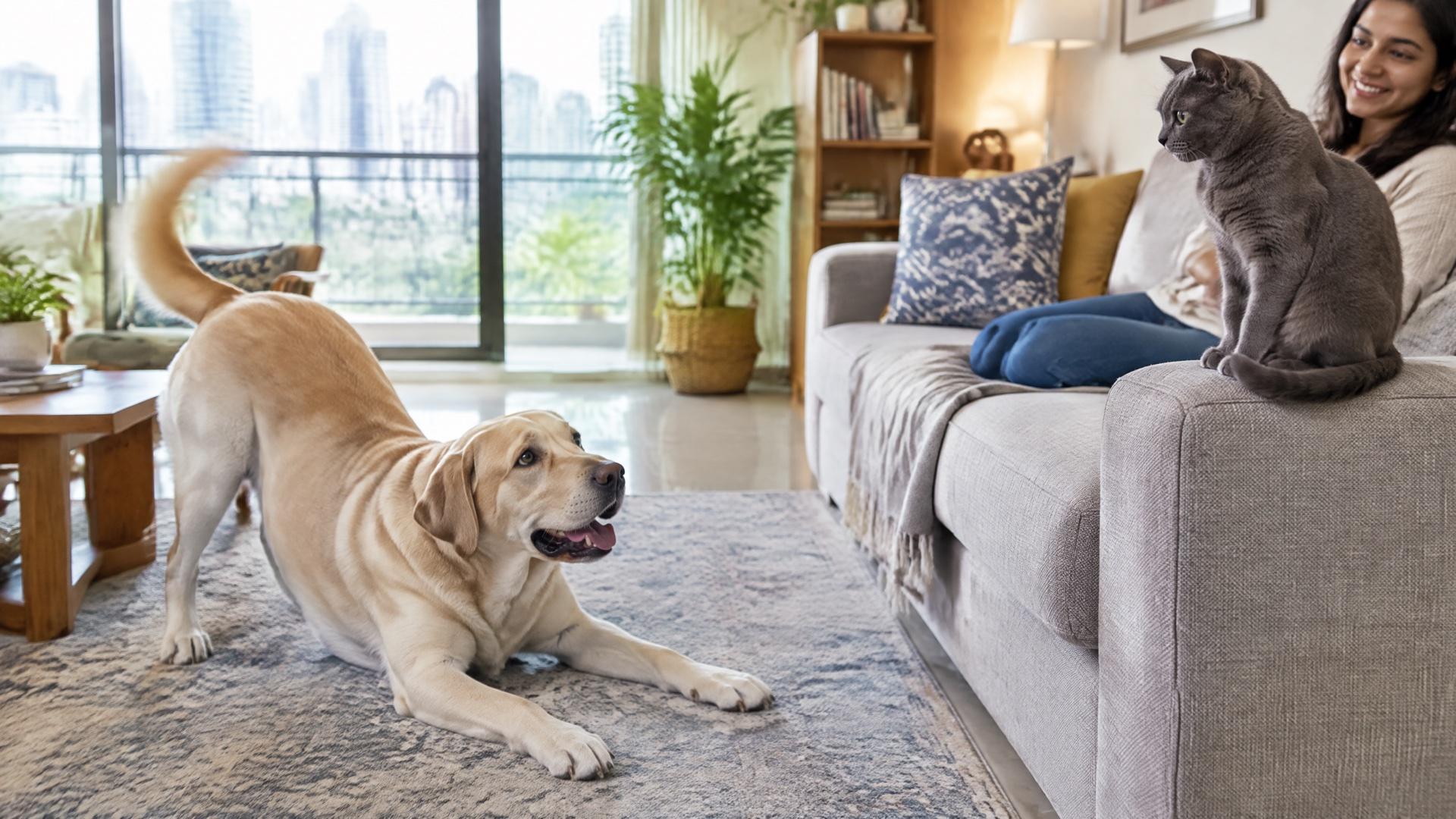
Your dog or cat is talking to you all day through its tail, ears, eyes, posture and voice, and the meaning depends on the whole body and the situation, not on one signal alone. In a busy Mumbai flat, with doorbells and visitors, your pet has plenty to react to. If you have ever wondered what dog behaviours mean, or why your cat flops at your feet, this guide decodes dog and cat body language for pet parents.
Key Takeaways
A wagging dog tail is not always a happy tail: speed, height and the rest of the body matter.
A cat's tail held up signals friendly intent, while a rapidly twitching tail can mean your cat is getting upset or angry.
Belly-up can mean relaxed or worried in dogs, and a cat's roll is usually a greeting, not a belly-rub request.
Any sudden change in behaviour is a reason to call your vet.
What Do Dog Behaviours Mean?
Dog behaviours are how your dog tells you what it is feeling, from happy and playful to worried or ready to defend itself. Dogs Trust, a UK dog welfare charity, says in its guide to understanding your dog's body language: "It's important to look at your dog's entire body – from head to tail." It adds that "Behaviours can have different meanings depending on the situation."
The American Kennel Club (AKC), a US dog breed registry, agrees in its guide to how to read dog body language: "No dog body language signal tells the whole story."
What Does a Dog's Tail Wag Mean?
A wagging tail means your dog is emotionally aroused, which can be happy, worried or alert. In the AKC's words, "a wagging tail simply indicates that the dog is emotionally aroused." Dogs Trust reads the tail like this:
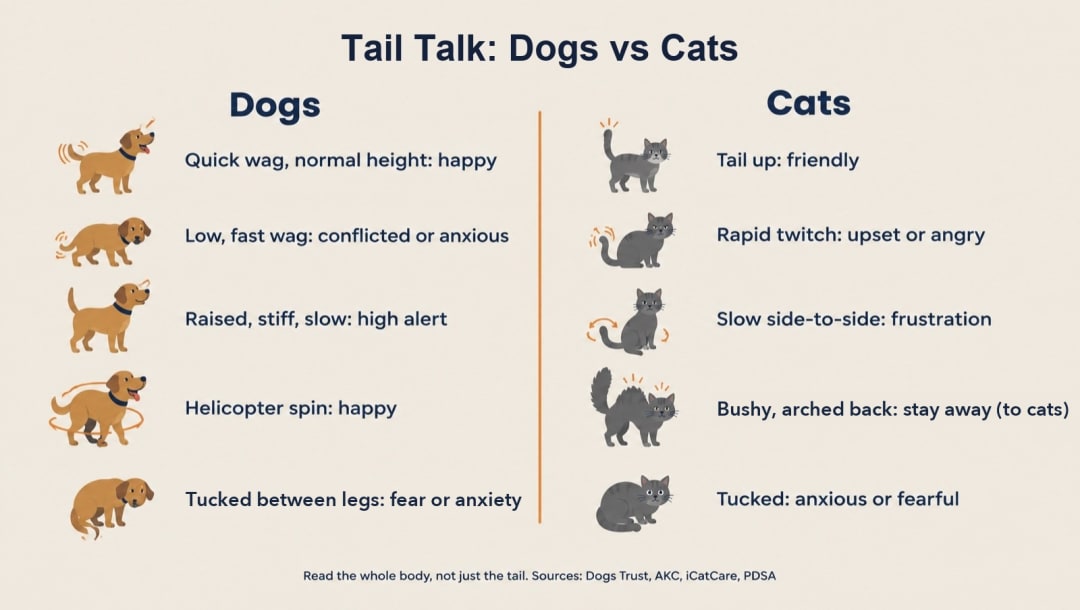
"A quickly wagging tail in your dog's normal tail position probably means they're happy."
"A tail that's low and wags quickly could be a sign of conflicted feelings or anxiety."
"A raised, stiff tail that moves slowly might mean your dog is on high alert."
"A tail that spins in a circle like a helicopter rotor means your dog is happy"
The AKC's article on why dogs wag their tails adds that "A tail lowered and between the legs could indicate fear, anxiety, or submission."
What Do a Dog's Ears, Eyes and Mouth Tell You?
Ears, eyes and mouth show whether your dog feels calm, worried or ready to act. Soft eyes "usually indicate calmness, comfort, or contentment," says the AKC, and a relaxed dog's mouth "could be closed, or open, and the tongue might loll out," according to Dogs Trust.
In an anxious or stressed dog, Dogs Trust says "The ears are held back and closer to the head" and "The whites of the eyes are visible". The AKC calls this whale eye: "Dogs frequently show whale eye when they feel anxious, worried, or pressured."
Some signals mean your dog needs space now:
"A prolonged hard stare is often a warning signal," the AKC says.
A snarl: the dog "is probably growling too", and Dogs Trust says this "signals that a bite could be next if they don't get the space they need."
For yawning, lip licking and other stress signals, see our guide to calming an anxious dog or cat. Context counts, though: Dogs Trust notes that "a dog might drool and lick their lips as their dinner is being prepared."
What Does a Play Bow or Belly-Up Roll Mean?
A play bow is an invitation to play, while a belly-up roll can mean either a relaxed request for a rub or a plea for space. "During a play bow, a dog lowers their chest to the ground while keeping their hindquarters elevated," the AKC explains.
"If your dog is relaxed and asking for a tummy rub they will be loose and floppy when they roll over in front of you," says Dogs Trust. But "Dogs use appeasement rolls when they feel threatened and need space immediately."
It also says "Some dogs will roll on their back for a belly rub from people they trust and in surroundings that feel safe." For more affection signals in dogs and cats, read our guide to signs your dog or cat loves you.
What Do Barks, Whines, Meows and Purrs Mean?
Barks, whines and meows are messages, and purrs can mean more than one mood. The ASPCA, a US animal welfare charity, says in its guide to why dogs bark that "Barking is one of many forms of vocal communication for dogs."
The AKC's guide to reasons your dog is whining says "The most obvious reason your dog may be whining is that they need or want something from you." It also says "Whining can be your dog's way of saying that they're feeling scared or anxious."
Cats meow mainly to talk to people, purr in many moods, and may hiss when unhappy. According to International Cat Care (iCatCare), an international cat welfare charity, "in most circumstances, meows are directed at people, rather than other cats."
Purring is not a guaranteed sign of happiness. The PDSA, a UK vet charity, warns: "Sometimes our cats can purr if they're anxious, worried or in pain". Cats Protection, a UK cat charity, puts it plainly in its guide to cat body language: "We often think that our cats are happy when they purr. This is only true if their body language is relaxed."
"Unhappy cats may also hiss at whatever is making them unhappy, or even swipe," the PDSA says.
What Do Cat Tail Movements Mean?
A cat's tail held up signals friendliness, while a twitching, swaying or puffed tail may signal trouble. iCatCare says in its guide to how cats communicate that the tail-up position "signals friendly intent when a cat approaches another cat, animal or person."
The PDSA explains in its guide to reading your cat's body language: "If your cat twitches their tail rapidly backwards and forwards, this is often a sign they're getting upset or angry."
iCatCare adds three more tail signals:
"a tail held out, moving slowly side-to-side across the body may signal frustration."
A bushy tail with an arched back and sideways stance is a "'stay away' signal to other cats."
"a tail tucked between the back legs is often a sign that a cat is anxious or fearful"
What Does It Mean When a Cat Flops on Its Back?
When a cat flops on its back in front of you, it is usually saying hello. iCatCare calls this a social roll, which is "usually carried out as a friendly greeting, showing that the cat is relaxed and comfortable or is in a playful mood."
The PDSA agrees a cat may greet you "by rolling on their back (but remember, this doesn't usually mean that they want belly rubs!)." If your cat bites or swipes at your hand, our guide to handling an aggressive cat during grooming explains the warning signs.
Why Do Dogs and Cats Scent Mark and Knead?
Scent marking is how dogs and cats leave messages, and kneading is a kitten habit some adult cats keep. VCA Animal Hospitals, a US vet hospital network, says in its guide to marking behaviour in dogs that "Scent marking with urine is considered normal dog behavior".
"Cats rubbing their heads against objects is known as 'bunting'," iCatCare explains.
As for kneading, Cats Protection's article on why cats knead says "Nursing kittens knead around the teat of their mother to better stimulate the flow of milk." For adults, it admits "no one really knows why this behaviour is carried into adulthood by some cats."
How Do You Read Your Pet's Body Language?
You read your pet's body language by noting what each body part is doing, then what is happening around it.
1. Learn Your Pet's Normal
Dogs Trust says "Often, a high tail carriage is just how a dog looks," so learn your dog's usual tail position.
2. Look From Head to Tail
Check the eyes, ears, mouth, tail and posture together. iCatCare says the same of cats: "Changes in position or movement of the eyes, ears and mouth, along with the cat's whole-body posture, are significant."
3. Check the Situation
A signal can mean something else in another moment, as with a dog licking its lips while dinner is being prepared.
4. Give Space When Your Pet Says Stop
Dogs Trust links a snarl or an appeasement roll to a dog that needs space, and the AKC calls a prolonged hard stare a warning signal. In cats, a hiss or a rapidly twitching tail can signal upset.
Common Mistakes to Avoid
Avoid these misreadings.
Assuming every wagging tail means a happy dog.
Reading a cat's moving tail the way you would read a dog's.
Rubbing a cat's belly because it rolled over to greet you.
Judging from one signal instead of the whole body.
When Should You Call a Vet About Your Pet's Behaviour?
Call your vet if your pet's behaviour changes suddenly or you can't find a clear cause, because pain or illness may be behind it. The ASPCA says "Dogs sometimes bark in response to pain or a painful condition." The AKC warns that "Whining could be an indication that your dog is in some kind of physical distress," and that when there's no clear cause, "you should take your dog to the vet to get them checked out."
For cats, iCatCare's guide to anxious cats says any behaviour change "shouldn't be ignored," and advises: "Contact your veterinary team and arrange for your cat to have a thorough examination."
Should I Tell My Groomer About My Pet's Stress Signals?
Yes, mention them in the booking note. FurDial's groomers come to your home across Mumbai, Thane, Navi Mumbai and Vasai-Virar, so there is no cage and no car ride, and every groomer has 5+ years of experience.
If your pet shows stress signals during handling, such as a twitching tail or a low, fast wag, the groomer may pause or reschedule if that is safer for your pet. For cats, The Glow Up (₹1,199, about 45 minutes) is a dry bath with no water or dryer. Prices include GST, with no travel charge, and only pets with up-to-date core vaccinations can be groomed. See all grooming packages and prices.
Frequently Asked Questions
Do Cats Meow at Each Other?
Rarely, once they are grown. iCatCare says meows "are rarely heard during adult cat–cat interactions".
Why Is My Dog Marking Inside the House?
Indoor marking can have a medical cause, so start with your vet. VCA advises that you "have your veterinarian examine him for any possible illness" if your dog urinates indoors. It adds that "Marking can be triggered by anxiety or frustration".
Why Do Cats Scratch Furniture?
Scratching leaves a message. iCatCare says it leaves "a scent mark, as well as a visual mark of their presence."
Final Thoughts
Read the whole body in context. Learn your pet's normal, respect the signals that say stop, and call your vet when behaviour changes without a clear reason.
When grooming time comes round, skip the car ride: book a FurDial groom at home and note any stress signals in the booking note.