
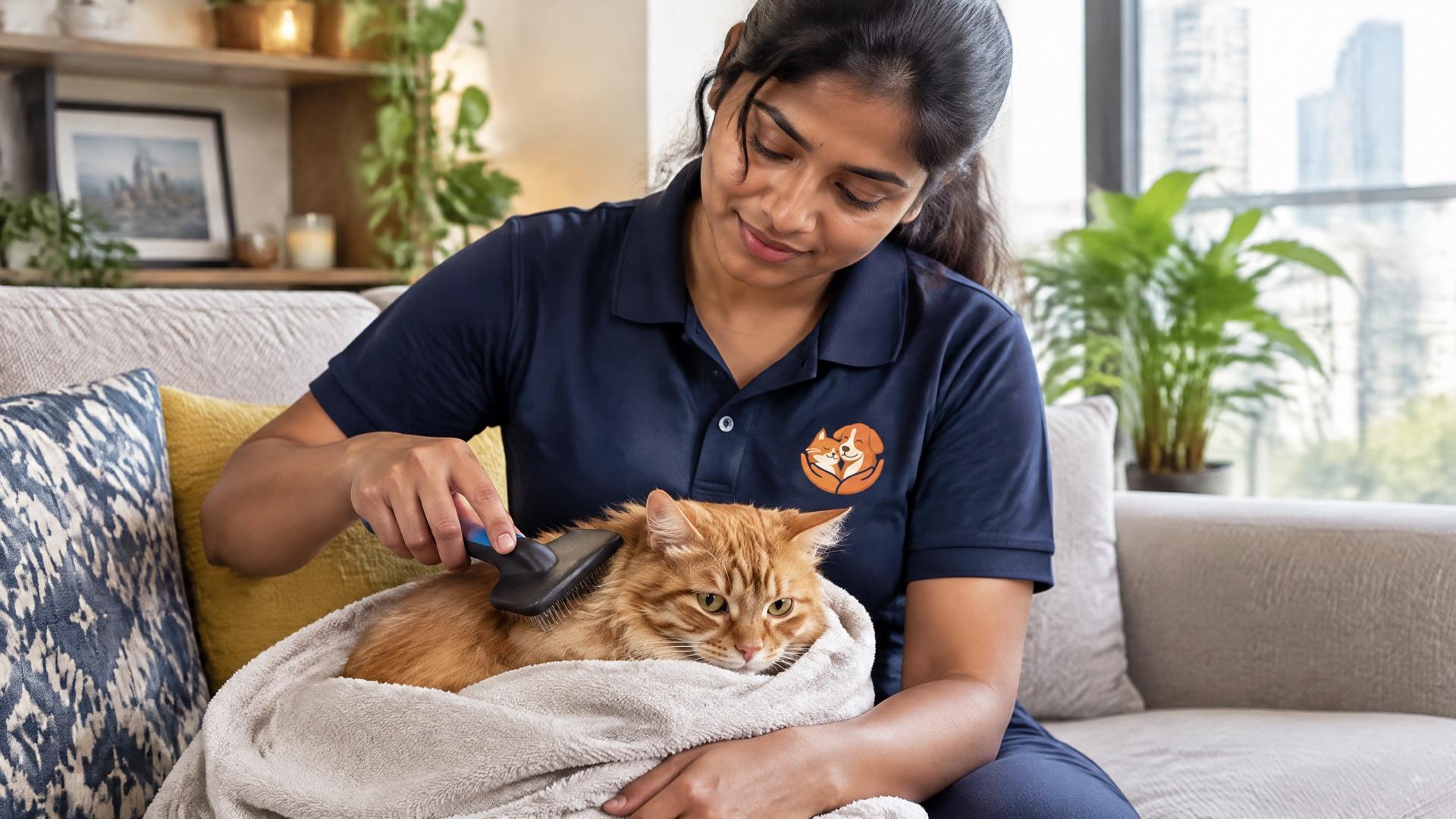
To handle an aggressive cat during grooming, rule out pain with your vet, keep sessions short, reward calm behaviour with treats, never scruff or force your cat, and stop at the first warning sign. Whether you share a compact flat in Andheri or a high-rise in Thane, a cat that hisses at the brush is telling you something. This guide to aggressive cat grooming explains why cats lash out, which body-language signals mean stop, and what to do if you get bitten.
Key Takeaways
Cats can lash out from fear, pain or overstimulation, so sudden aggression needs a vet check first.
Stop as soon as you see flattened ears, a flicking tail, wide pupils, hissing or growling.
Never scruff, punish or force a cat. Short sessions with treats and a way to escape work better.
For a bite that breaks the skin, wash it with soap and water. Cleveland Clinic advises seeing a doctor within eight hours.
Why Do Cats Get Aggressive During Grooming?
Cats can lash out during grooming because they're frightened, in pain or overstimulated. The Cornell Feline Health Center, part of Cornell University's vet college, explains in its guide to feline aggression that fearful cats may "flatten their ears against their heads, hiss, bare their teeth, or crouch low to the ground".
Pain can trigger it too. The ASPCA, a US animal welfare charity, notes in its page on aggression in cats that "even a well-socialized, normally docile cat can lash out when he's hurt."
Some cats bite during stroking or brushing that they seemed to enjoy a moment earlier. This is called petting-induced aggression, and experts are not certain why it happens. VCA Animal Hospitals, a network of vet hospitals, says in its guide to petting aggression that the cause "is not always clear". Overstimulation is one explanation. Cats Protection, a UK cat charity, adds in why does my cat bite me? that a cat may also be "overexcited".
What Are the Warning Signs a Cat Is About to Bite?
Flattened or rotating ears, a flicking or lashing tail, wide pupils, a tense body, hissing and growling are the main signs to stop. Cornell says petting-induced aggression is preceded by "dilated pupils, tail lashing, and ears moved backward". The ASPCA lists "Twitching or flipping his tail", and VCA says cats "pull their ears back, tense their body, or begin to flick their tail".
International Cat Care, a UK cat welfare charity, adds subtler signs in its guide to handling and interactions, including "Twitching/rippling skin along their back", head shaking and lip licking. Cats Protection lists "hissing, crouching low to the ground, flat ears, wide eyes, an arched back, tense tail".
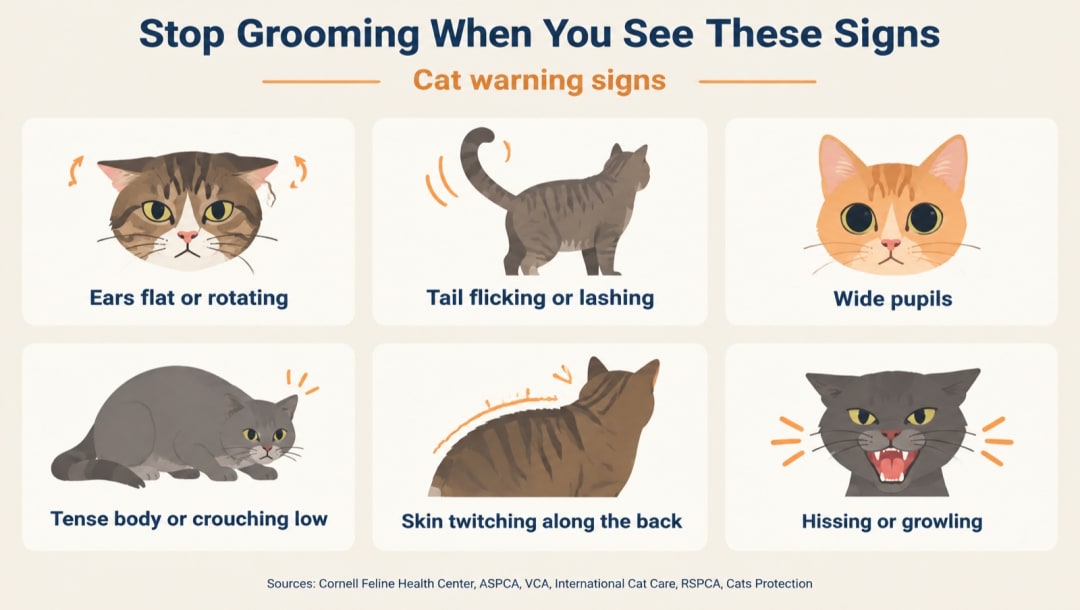
The ASPCA's advice is simple: "When your cat signals you to stop petting, the best response is simply to stop." The same applies to the brush.
Could Pain Be Causing My Cat's Aggression?
Yes, and it's the first thing to rule out. Cornell says "The first step in managing an aggressive cat is to ensure that there is no medical reason", and the ASPCA recommends checking for "painful diseases such as arthritis, dental pain and abscesses".
VCA says "Pain can trigger an aggressive response to being touched", especially if your cat bites when you touch one particular area, and that unexpected aggression calls for a "thorough examination". Its guide to signs of pain in cats lists "Lashing out if handled" and "Avoiding or resenting being brushed or combed".
Arthritis and mats often go together. VCA notes that "Most cats with osteoarthritis stop grooming themselves as well as they used to." International Cat Care's guide on how to spot signs of pain in cats says "Cats with joint pain may also develop matts in their coat as they cannot position themselves comfortably to groom." A brush then tugs at those mats, and the ASPCA's cat grooming tips warn that "Matted hair can be painful and lead to underlying skin problems."
International Cat Care is clear: "Veterinary attention should always be sought if you think your cat is in pain or are unsure."
How Do I Calm Down an Aggressive Cat?
Stop what you're doing, step back and give your cat space to move away. International Cat Care's handling guide says to give a cat "the chance to move away" and to "Never use forceful handling."
Don't shout or punish. Cornell warns that "Any type of physical punishment can increase a cat's fear or anxiety and worsen aggression," and the ASPCA's grooming tips say "If your cat resists, don't raise your voice or punish her."
Try again on a calmer day. International Cat Care's guide to grooming your cat says growling or hissing means stop and try "another day".
How to Groom an Aggressive Cat, Step by Step
Groom an aggressive cat in short, rewarded sessions after a vet has ruled out pain, and stop before your cat gets upset.
1. Rule Out Pain First
Book a vet check if the aggression is new or centred on one body part. The ASPCA says "The first step... is to have a complete veterinary exam."
2. Play First, Then Groom
The ASPCA suggests playing with your cat first to tire them out before grooming.
3. Start Where Your Cat Likes to Be Touched
International Cat Care says cats generally prefer touch on the cheeks and chin, while areas such as the belly are more sensitive. Begin with the easy spots.
4. Keep It Short and Reward Calm
The RSPCA, a UK animal welfare charity, says in its guide to grooming your cat that "short, regular sessions are best" and to "Use praise and treats". VCA suggests keeping sessions "short enough to stop before these signs appear" and tossing a treat to reward calm behaviour.
5. Use a Loose Towel for Comfort, Not Restraint
Fear Free Happy Homes, a pet-parent resource from the Fear Free programme, suggests in its guide to preparing cats for vet exams practising with "a folded bath towel, a tool used by many veterinarians for handling cats". VCA's guide to handling exercises for nail trims suggests holding a cat on your lap "or wrapped in a towel". Our advice: drape the towel loosely and let your cat leave. Never wrap a panicking cat tightly.
6. Stop Early and End on a Good Note
International Cat Care advises sessions "as short or long as your cat is comfortable with" and to "finish on a positive note". Fear Free says "If your cat hisses or growls, stop immediately," and to spread practice "over multiple days".
Should You Scruff or Restrain a Cat for Grooming?
No. International Cat Care says "Cats should never be scruffed (held by the skin at the back of their neck)" and "Your cat should never be forcibly groomed or stroked without the option to escape."
The FelineVMA (Feline Veterinary Medical Association, formerly the AAFP) goes further in its 2026 respectful handling guidelines, saying scruffing and similar methods "should NEVER be utilized in any setting". It explains that "A cat's ability to have choice and a sense of control during interactions minimizes distress."
For cats who truly can't cope, the FelineVMA says "Chemical restraint and not physical restraint should be used if needed." That is a decision for your vet. Our advice: never give your cat any medicine to calm it unless your vet prescribes it.
What Should You Do If a Cat Bites or Scratches You?
Stay still, then clean the wound straight away. Cats Protection advises, "Stay as still and calm as possible." The ASPCA warns that "Cats can bite and inflict severe lacerations, which are painful and can easily become infected."
For a bite that breaks the skin, Cleveland Clinic, a US academic medical centre, advises in its guide to cat bites and scratches:
Rinse with water, then "wash the wound with soap and water".
"See a doctor within eight hours to cut your infection risk."
Watch for "redness, swelling, increased pain and fever".
A tetanus vaccine "may be recommended".
Cleveland Clinic adds that rabies "remains a risk", particularly with a stray or feral cat, which matters if you help care for neighbourhood cats in Mumbai. Cleveland Clinic says infection risk is higher if you're "immunocompromised or have diabetes". For minor scratches, Cats Protection says "If the wound becomes infected or does not heal, seek medical help." The ASPCA notes scratches can also cause "cat scratch fever".
Common Mistakes to Avoid
Scruffing, pinning or forcing your cat to stay put.
Punishing or shouting at your cat after a swipe.
Pushing on through tail flicks, flat ears or growls.
Cutting out mats with scissors. VCA says "never scissors", and the RSPCA suggests a dematting comb instead.
Assuming a cat that suddenly turns grumpy is just being difficult, rather than in pain.
Giving any calming medicine without your vet's advice.
When Should You Call a Groomer or a Vet?
Call your vet first for new aggression or severe mats, and a groomer for routine coat care once pain is ruled out.
Call a vet when:
your cat becomes aggressive suddenly, or only when one area is touched
you notice other signs of pain, such as hiding or a scruffy, matted coat
mats are tight to the skin. International Cat Care says "severe matts will need to be shaved off by your veterinary team. This often requires sedation or a general anaesthetic".
Call a groomer when:
your vet has ruled out pain, but brushing or nail trims are still a struggle (the ASPCA suggests you "ask your vet or a groomer for help" with claws)
your cat's coat needs a bath, trim or comb-out and the skin underneath looks healthy
Can a Groomer Handle an Anxious or Aggressive Cat at Home in Mumbai?
Yes, as long as grooming stays safe for your cat, though no groomer should force a cat that can't cope. FurDial's groomers come to your home across Mumbai, Thane, Navi Mumbai and Vasai-Virar, so there's no carrier, no cage and no car ride. Every groomer has 5+ years of experience.
Mention your cat's anxiety or aggression in the booking note. The groomer may pause or reschedule if that is safer for your cat. Free cancellation applies until a groomer accepts the booking.
The Glow Up, ₹1,199, about 45 minutes: a dry bath with waterless shampoo or foam (no water or dryer), plus ear, eye and paw cleaning. Nail clipping is included, and a full body haircut, trim or zero cut can be added at booking.
Snip & Purr, ₹1,799, about 60 minutes: a bath with shampoo for sensitive feline skin, a calm blow dry, a full body haircut (zero cut, trim or styled finish, agreed before starting), ear, eye and paw cleaning, deep combing to clear tangles and loose fur, nail clipping and sanitary cutting.
Prices include GST, with no travel charge, and you can pay after the service by UPI or cash, or pay online. Only cats with up-to-date core vaccinations can be groomed, and heavy matting may carry a small surcharge, told on arrival before starting. See how an at-home groom works and all grooming packages and prices.
Frequently Asked Questions
Do Cats Feel Better After Being Groomed?
Grooming can help, as long as your cat is comfortable. International Cat Care says grooming "has several benefits" and "can be very therapeutic for both of you". The ASPCA says brushing "stimulates blood circulation, improving the overall condition of her skin", and the RSPCA says it "removes dust, dead skin and loose hairs".
How Can I Groom My Cat Myself?
Brush in short, regular sessions, reward with treats and stop at any warning sign. The ASPCA notes that "There are some cats who do not tolerate being groomed," so ask your vet if home grooming isn't working. For a routine, see our guide on how often a cat should be groomed.
Why Does My Cat Bite When Brushed?
It may be overstimulation, fear or pain. Cats Protection says new biting means "speak to your vet as it may be a sign that your cat is in pain".
Can I Give My Cat Something to Calm It Before Grooming?
Only if your vet prescribes it. The FelineVMA prefers chemical restraint over physical restraint where needed, and that choice belongs to your vet. Our advice: don't give your cat any medicine or supplement on your own.
Final Thoughts
An aggressive cat may be frightened, sore or overstimulated. Rule out pain with your vet, watch for the warning signs, keep sessions short and never scruff or punish.
If your cat needs a gentle groom without a car ride, book a FurDial groom at home and mention your cat's nerves in the booking note.