
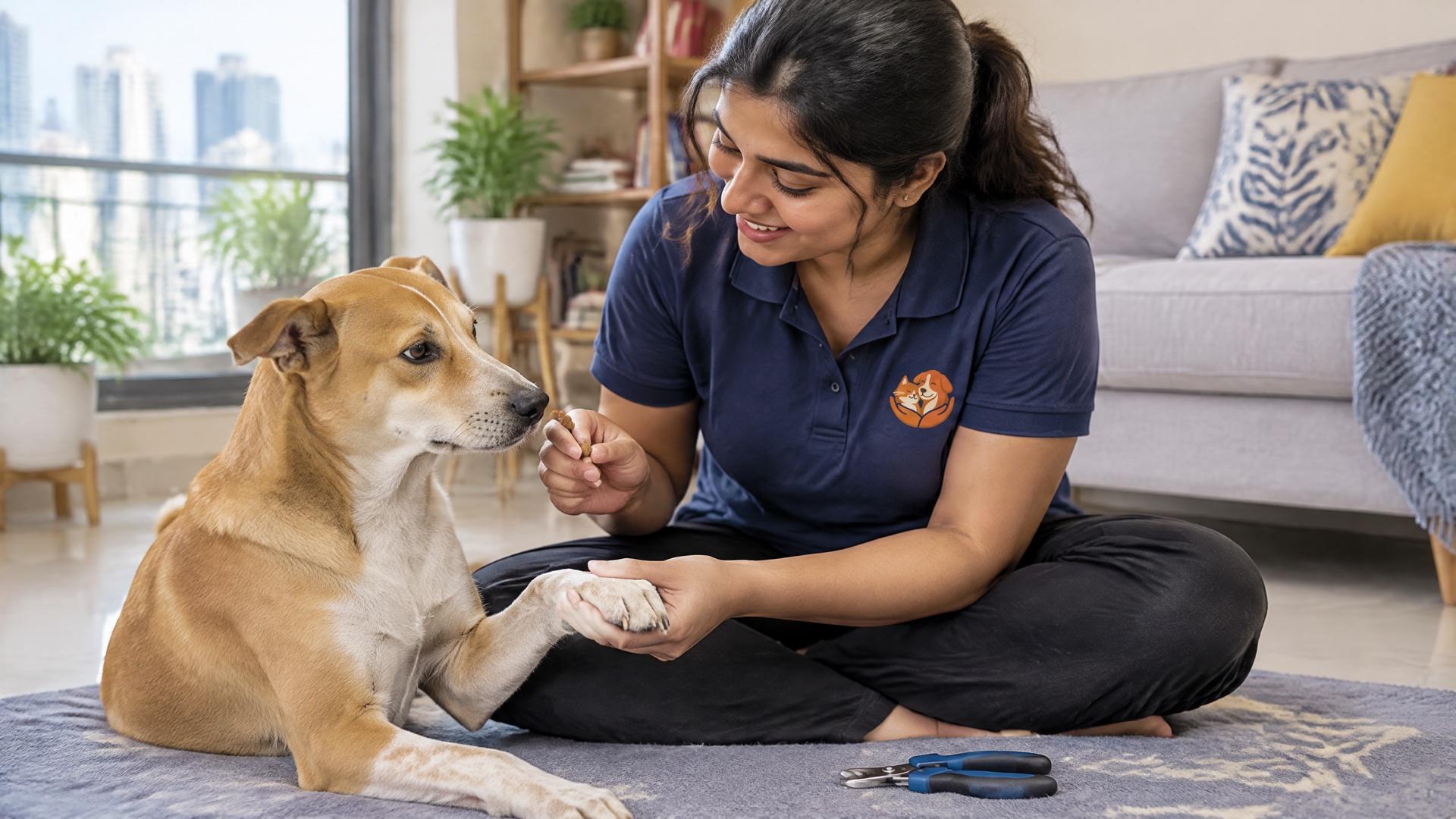
To calm a dog or cat during nail clipping, don't force it: teach your pet, in tiny steps over weeks, that paw handling and clippers lead to treats, and start by clipping just one nail. In a Mumbai flat, with traffic, doorbells and festival noise, it also helps to pick a quiet moment. This step-by-step guide shows how to calm a dog during nail trimming, covers cat nail trimming anxiety, and explains when to stop and call your vet. For the cutting technique itself, see our guide to trimming your dog's nails at home.
Key Takeaways
Fear of nail trims often comes from paws that were never handled, a painful past cut, or a noisy grinder.
Break the trim into tiny steps, pair each one with a tasty treat, and keep sessions to a minute or two at first.
Start with one nail, never force or scruff your pet, and stop at the first sign of stress.
If fear doesn't ease, see your vet. Only a vet can decide whether calming medicine is right.
Why Are Dogs and Cats Scared of Nail Trims?
Pets often fear nail trims because paw handling feels strange, a past trim hurt, or the tools are noisy. The AKC (American Kennel Club), a US dog breed registry, says in its guide to desensitisation and counterconditioning that some dogs "dislike nail trims because they never learned to be comfortable with you touching their paws."
VCA Animal Hospitals, a network of vet hospitals, notes in its guide to handling exercises for nail trims that dogs have "more nerve endings in their feet and toes" than on other body parts.
One bad trim can stick. Fear Free Happy Homes, a pet-parent advice site whose articles are reviewed by veterinary behaviour professionals, says in its guide to nail anatomy that cutting the quick is "a painful experience", and a dog can then "become anxious and worried about his paws."
Noise and force add to it. Dogs Trust, a UK dog welfare charity, says in its advice on dog nails that grinders "might take longer to use and have a louder noise." VCA's guide to taking the stress out of nail trims warns that forcible restraint and tricks can "damage the dog's trust in being touched and groomed."
What Are the Signs Your Pet Is Stressed During a Nail Trim?
Pulling the paw away, trembling, looking away, yawning and lip licking are common signs in dogs, while cats may flatten their ears, hide or hiss. Spot them early, before your pet escalates.
Signs in Dogs
Watch for "Pulling the paw away," "Trembling," and vocalising, such as whining, growling or barking, which VCA's handling guide lists as signs of stress during handling. VCA's stress guide adds "not coming closer, moving away, looking away, leaning away, yawning." Dogs Trust's guide to dog body language also lists:
"lip licking (without food)"
"yawning (without tiredness)"
"shaking, trembling (without feeling cold)"
a tucked tail, or a raised paw that can mean a dog is unsure
"tension in the face and body"
Dogs Trust explains that if early signals are missed, a dog "may feel the need to 'shout'", and that snapping is "a warning that a bite could be next."
Signs in Cats
Cats Protection, a UK cat charity, says in its guide to cat body language that stressed cats may "hide or get up high", with flat ears and wide pupils. Unhappy cats may show "Hissing and swiping", "Puffed-up fur", "Slow, guarded movement" or "Excessive lip licking".
How Do You Calm a Dog to Trim Their Nails?
You calm a dog to trim their nails with desensitisation and counterconditioning: tiny steps, each paired with a treat your dog loves. VCA's handling guide explains that "Desensitization means breaking down the process into a series of tiny steps," and "Counterconditioning means creating a positive emotional response, typically by giving delicious treats."
The AKC says desensitisation starts "at low levels of the stimulus", keeping your dog below threshold, and counterconditioning pairs "every presentation of the stimulus with something your dog finds fabulous."
Dogs Trust suggests first teaching your dog "not to be worried about having their paws handled", "over a couple of weeks or longer if necessary", and adds: "Always pair this with a tasty treat."
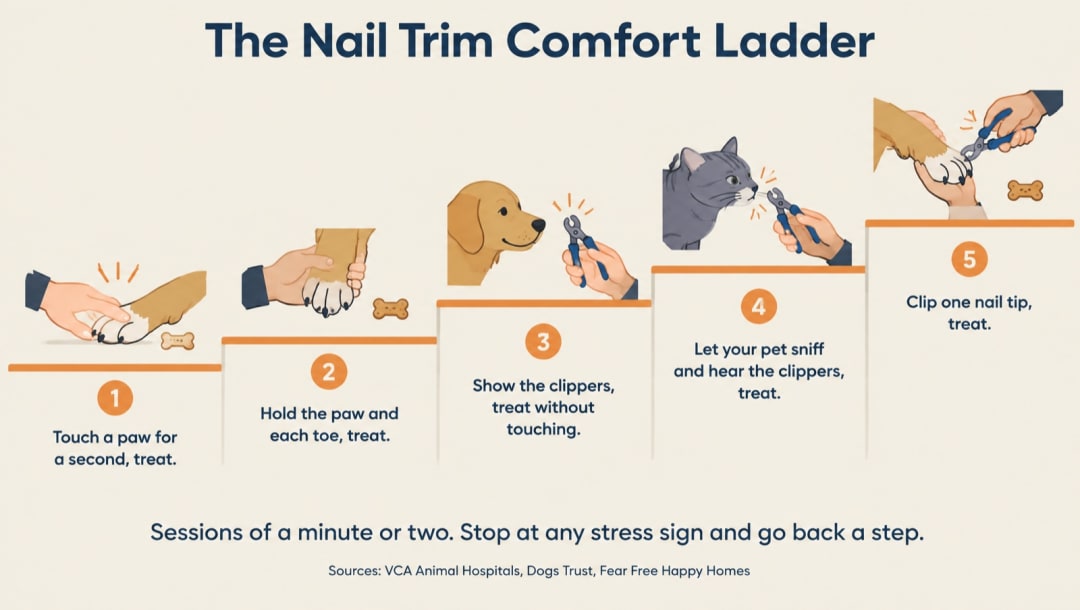
How Do You Keep Your Dog Calm While Clipping Nails, Step by Step?
Climb one small step at a time, treat at every step, and move on only when your dog looks relaxed. VCA's stress guide advises breaking the trim "into many small steps".
Step 1: Pick a Quiet Time and a Comfortable Spot
Our advice: in a busy Mumbai flat, choose a time with less traffic noise and no deliveries due, and skip festival evenings with firecrackers. VCA suggests trims "in your lap, in a dog bed, or even on a grooming table", on a non-slip surface. The PDSA, a UK vet charity, says in its guide to clipping your dog's nails to hold the paw in a position "comfortable for them", with a helper if your dog is wiggly.
Step 2: Touch a Paw, Then Treat
Touch one paw briefly, then give a treat. Repeat until your dog stays relaxed.
Step 3: Hold the Paw and Handle Each Toe
Hold the paw a little longer and move to each toe. VCA advises a treat with each change of paw position. Build up to all four paws.
Step 4: Introduce the Clippers or Grinder
Hold the clippers and treat without touching the foot, as VCA suggests. For a grinder, VCA advises switching it on at a distance first, then giving a treat.
Step 5: Clip One Nail
VCA suggests taking "a tiny flake from the tip of one nail", rewarding your dog, and trying the next nail later that day. Dogs Trust agrees: "Only trim one nail initially." Our dog nail trimming guide, linked above, covers where to cut and how to avoid the quick.
Step 6: Add Nails Slowly
Start with one nail, and build up only if your dog stays calm. Fear Free Happy Homes suggests that once you can do a few nails on one paw, you stop and play: "Tomorrow you can do another paw."
How Long Does It Take to Get a Pet Used to Nail Trims?
It can take weeks or months, especially if your pet is already afraid. VCA's stress guide says existing fear "may take weeks, months, or longer", and the AKC says "this process can take months." For cats, Fear Free Happy Homes says getting used to trims may take several weeks.
Keep sessions very short, a minute or two at first. VCA's stress guide suggests "just a minute or two" and "a few days a week". VCA's handling guide builds towards 3 to 5 minutes over time, but still says: "Keep sessions short."
How Do You Calm a Cat for Nail Trimming?
Calm a cat with the same tiny, treat-paired steps, gentle handling and no scruffing, but first check whether your cat needs trims at all. International Cat Care (iCatCare), a UK-based international cat welfare charity, says in its guide to trimming your cat's claws that routine claw trimming "isn't advisable", because most cats wear their claws down by scratching. Older, less mobile or indoor cats may need trims. Trim only when needed, and ask your vet whether your cat does. Our guide to how often a cat should be groomed covers claw checks.
A Gentle Plan for Cats
Fear Free Happy Homes' 8 steps to fear-free cat nail trims start by stroking one paw "for just a second or two", then holding it "for a few seconds", building to all four paws over several days. Next come a paw massage, gently pressing to extend a claw, and letting your cat sniff the clippers and hear them. Only then do you clip one nail tip. It recommends "extra yummy treats" and ending each session before your cat becomes restless.
Lap or Towel?
iCatCare suggests your cat sits facing away, ideally relaxing on your lap, or that you "gently wrap your cat in a towel with one leg free." VCA's handling guide agrees that "Many cats prefer to be gently restrained on your lap or even bundled into a towel."
A towel is optional. If you use one, keep it loose and gentle, never tight. iCatCare advises asking your vet to "show you how to safely do this at home."
Never Scruff a Cat
iCatCare's pledge to go scruff free opposes scruffing, "firmly gripping the loose skin at the back of the cat's neck", because of the "stress and distress it can cause."
When Should You Stop a Nail Trim?
Stop as soon as your pet shows signs of worry. If your pet becomes concerned, VCA's handling guide says to "stop and go back to an easier step", and to take a break at stress signs. Dogs Trust says if your dog "appears worried, stop" and return to the last comfortable step.
For cats, iCatCare says: "If your cat becomes anxious, stop and try again another time."
Ending on a calm note matters more than finishing every nail.
What Can You Give a Dog to Calm Them for Nail Trims?
Only your vet can decide whether your pet should have any calming medicine, so ask your vet before giving any medicine. VCA's stress guide says "Some dogs benefit from medicines prescribed by the veterinarian to reduce fear and stress".
VCA's guide to medication for stressful vet visits in cats says your vet may prescribe an anti-anxiety medicine for cats with severe stress, but only for healthy animals.
Medicine isn't a shortcut. Fear Free Happy Homes' guide to pre-visit medications says they are "never recommended alone without training, behavioral, or environmental modification". Never give your pet human or leftover medicines.
Common Mistakes to Avoid
Holding your pet down. VCA warns that forcible restraint "by hand or in a device such as a hammock or sling" risks making fear worse. The Royal Kennel Club, the UK's kennel club, says in its guide to long nails in dogs, "you should never try and force your dog to have their claws trimmed."
Distract-and-clip tricks. VCA advises against trying to "give a spoonful of peanut butter, then quickly try to trim", which often makes fear worse.
Scruffing a cat. iCatCare opposes it because of the stress it causes.
Rushing. Clipping every nail before your pet is ready skips the small steps. VCA advises moving on only when your dog looks comfortable.
When Should You Call a Groomer or a Vet?
Call your vet if your pet's fear isn't improving or it growls, hisses or snaps.
Call a vet when:
your pet shows significant stress or aggression. The Royal Kennel Club says to consult your vet, "who may in turn refer you to a behaviourist."
your pet is already afraid. VCA's stress guide says "it is often best to seek personalized, professional help."
you're making no progress after a few weeks. See a vet, or, as VCA's handling guide suggests, a behaviour consultant or trainer skilled in teaching nail care.
the nails are very long. VCA says a vet "can use a light sedative to quickly trim the nails."
Call a groomer when your pet accepts paw handling but you aren't confident cutting its nails. A groomer suits routine trims, but a groomer is not a vet or a behaviourist.
Can a Groomer Clip an Anxious Pet's Nails at Home in Mumbai?
Yes. FurDial's groomers clip dog and cat nails at home across Mumbai, Thane, Navi Mumbai and Vasai-Virar, with no cage and no car ride. See the areas we cover.
Dogs: every package includes nail clipping and filing, with nails trimmed to a safe length and edges smoothed. Packages start with The Clean Aesthetic at ₹1,699 (about 90 minutes).
Cats: both The Glow Up (₹1,199, about 45 minutes) and Snip & Purr (₹1,799, about 60 minutes) include nail clipping.
If your pet is anxious, mention it in the booking note. The groomer may pause or reschedule if that is safer. Every groomer has 5+ years of experience, and only pets with up-to-date core vaccinations can be groomed. Prices include GST, there's no travel charge, and you can pay after the service by UPI or cash, or pay online. See all grooming packages and prices.
Frequently Asked Questions
Can I Give My Dog Human Medicine Before a Nail Trim?
No. Never give your dog human or leftover medicines. Ask your vet, who is the only person who can decide whether any medicine suits your pet.
Is a Nail Grinder Less Scary Than Clippers?
Not necessarily. Dogs Trust notes that grinders might be louder and take longer to use, so if you use one, switch it on at a distance first and treat, as VCA advises.
What If My Pet Only Lets Me Clip One Nail?
That is progress, not failure. VCA suggests rewarding your dog after one nail and trying the next later that day. If your pet gets worried, the PDSA says to "stop, give them a treat and try again another time."
Final Thoughts
Go slowly, treat every small step, clip one nail at a time and stop the moment your pet looks worried. If fear isn't easing, see your vet.
If your pet accepts paw handling and you'd like a professional to trim its nails, book a FurDial groom at home and mention any anxiety in the booking note.