
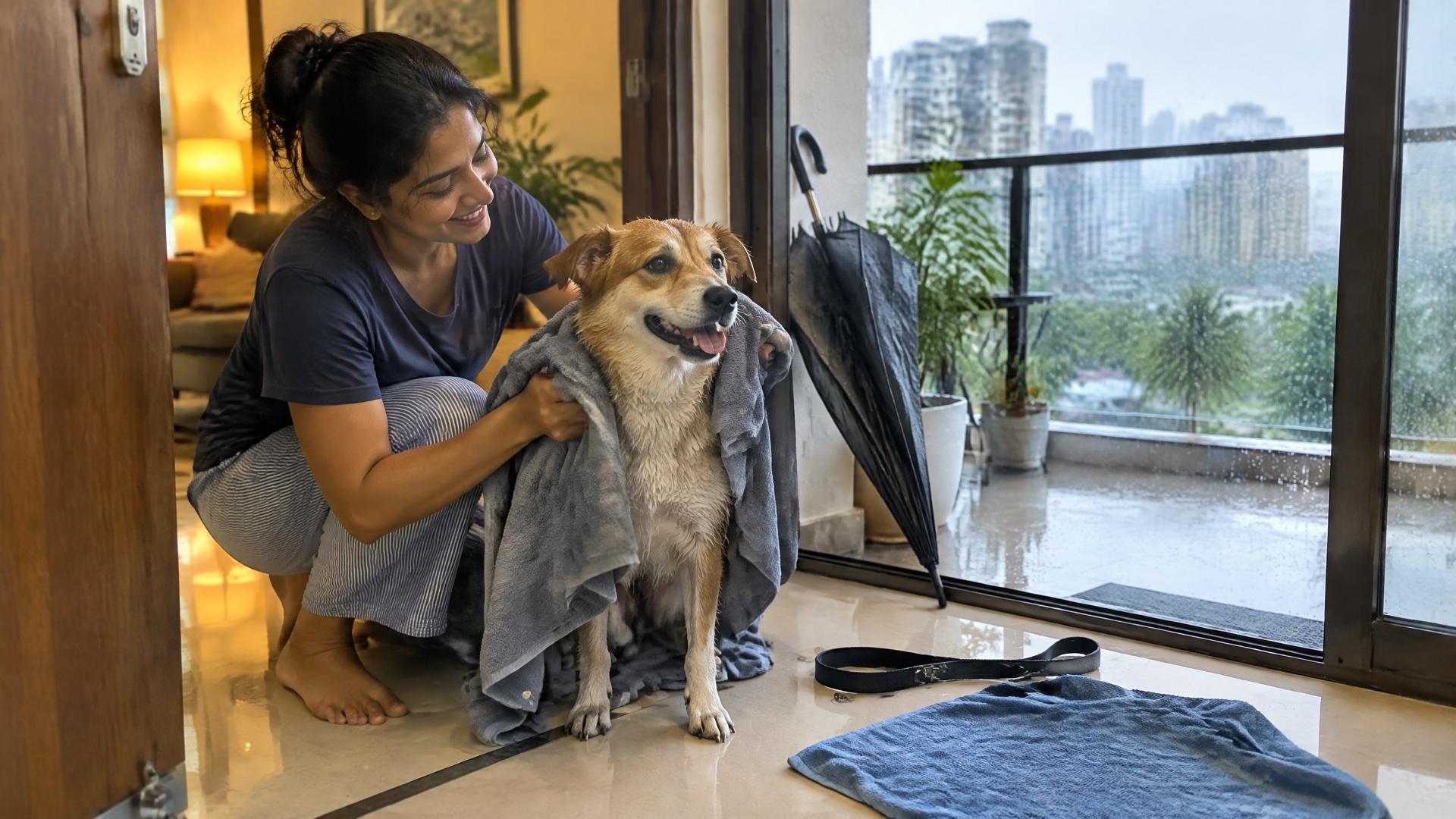
To keep your pet healthy in the monsoon, dry the coat and paws thoroughly after every walk, check for ticks daily, keep your dog away from stagnant water and talk to your vet about tick, flea and leptospirosis prevention. Mumbai's monsoon means soaked walks and damp flats. This guide to dog care in rainy season covers what to check, what to prevent and when to call a vet.
Key Takeaways
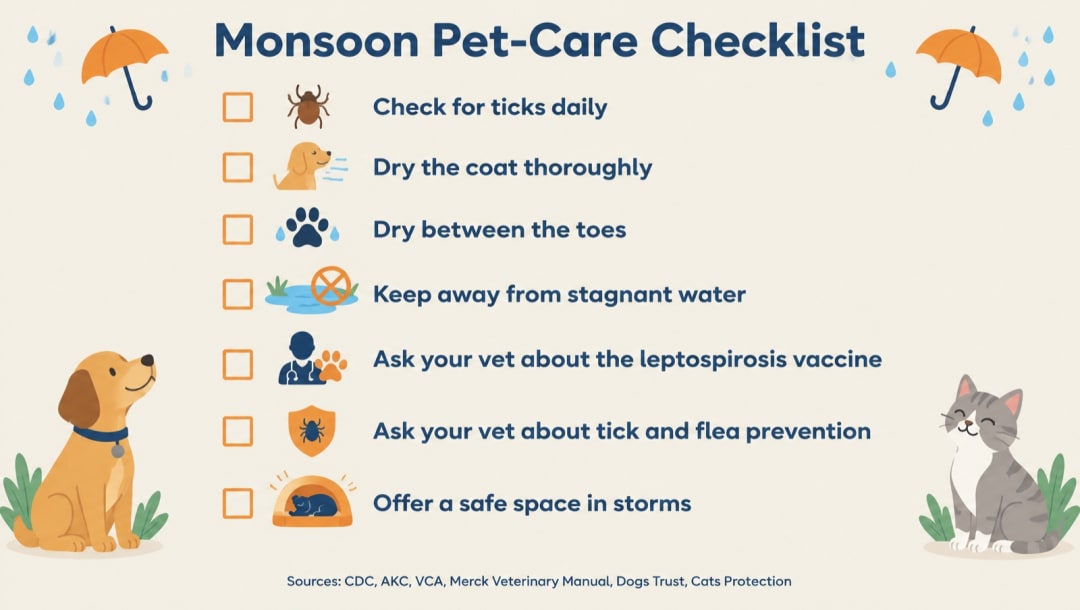
Check for ticks daily and ask your vet about tick and flea prevention.
A wet coat can lead to hot spots, so dry to the skin and between the toes.
Keep dogs away from stagnant water and floodwater, and ask your vet about the leptospirosis vaccine.
Give a frightened pet a safe space during thunder, and never punish fear.
Why Are Ticks a Bigger Problem in the Monsoon?
Ticks are more active in warm, humid weather, and Indian research links the monsoon to more tick-borne disease in dogs. A study of canine blood-parasite diseases in Chennai found the "Maximum number of cases were recorded during Monsoon season (June to September)". The authors linked the rise in ehrlichiosis to temperature and humidity, which "accounts to the increased tick activity".
Mumbai was one of four sites in a survey of canine tick-borne diseases in India, where lab tests found tick-borne infections in 261 of 525 dogs (49.7 per cent) across the sites.
VCA Animal Hospitals, a large network of vet hospitals, says in its guide to ehrlichiosis in dogs that the disease is "usually carried by the brown dog tick".
How Do You Check for and Remove Ticks Safely?
Check for ticks on dogs every day, and remove any tick by gripping it close to the skin without squeezing its body. The CDC, the US public health agency, says in its guide to preventing ticks on pets: "Check your pets for ticks daily, especially after they spend time outdoors." Look around the ears and eyelids, under the collar and front legs, between the toes and on the back legs and tail. The CDC also suggests asking your vet about "The best tick prevention products for your dog".
The American Kennel Club (AKC), the US breed registry, says in its guide to removing a tick from your dog to "Grasp the tick as close to the skin as possible using fine-point tweezers" and "Pull straight upward in a slow, steady motion". It also says to "Avoid twisting or jerking, which can cause the mouthparts to break off in the skin." It adds: "Never remove a tick with your fingers."
The PDSA, a UK vet charity, recommends a different method in its guide on how to remove a tick from a dog or cat: "Slide a tick-twisting tool under the tick, as close to your pet's skin as possible", then twist in one direction. It warns: "Never remove a tick by pulling, crushing, or squeezing it." The two sources disagree on twisting, so pick one method and ask your vet to show you. Both agree on gripping close to the skin, never squeezing the body and never using your fingers. Afterwards, clean the bite and watch for redness, heat or tiredness. If you're unsure, the PDSA says "ask your vet practice for help."
How Do You Know If Your Pet Has Fleas?
Part the fur and look for fleas or dark specks of flea dirt. The Merck Veterinary Manual's pet-owner guide to fleas in dogs says that on "a damp paper towel, the excrement dissolves, producing a reddish brown color".
Merck says fleas "transmit a wide variety of diseases, including tapeworm infections". Its advice: "You should discuss flea control products with your veterinarian."
What Causes Hot Spots and Skin Infections in the Rainy Season?
A coat that stays damp against the skin can set up hot spots, painful patches of inflamed skin. VCA's guide to hot spots in dogs explains that "Matted fur prevents air from reaching the skin and retains water after a dog swims or gets caught in the rain." It adds that "Some dogs also benefit from seasonal grooming, as well as regular brushing and bathing." See our guide on how often you should brush your dog.
A vet writing for the AKC on hot spot prevention says they are "more likely to occur during warm weather and periods of high humidity" and advises keeping coats "thoroughly dry".
Fungal infections rise too. A study of ringworm-causing fungi in dogs and cats around Kolkata, published in Veterinary World, concluded that "fungal infections are mostly prevalent during rainy seasons, in pet animals such as cats and dogs." Any oozing, scaly or bald patch needs a vet. VCA warns against giving pets human medicines.
Why Does My Dog Smell So Bad After Rain, and How Do You Stop It?
Wet dog smell after rain comes from compounds that microbes leave on the coat, released as the water dries. The AKC explains in why wet dogs smell bad that the odour "comes from moisture evaporation that carries some of those compounds with it."
The fix is drying. The AKC says "If your dog comes home wet, it's best to dry them before they get a chance to move around the house."
Check the ears too. VCA's guide to ear infections in dogs says infected ears "may develop a bad odor". That needs a vet.
Can Dogs Get Leptospirosis From Puddles and Floodwater?
Yes, leptospirosis can spread through contaminated water, and the risk rises after heavy rain. VCA's guide to leptospirosis in dogs says the bacteria survive "in warm, stagnant water or moist soil" and "infection risk for people and animals is increased after hurricanes, heavy rain, or flooding."
The CDC's page on leptospirosis in animals says dogs catch it through "Direct contact with infected urine (pee) or contaminated water sources." Closer to home, Maharashtra Animal and Fishery Sciences University researchers reported Leptospira in animals and water around Mumbai, with dogs showing "the highest seropositivity".
VCA lists early signs as "reduced or no appetite, lethargy, and high fever". Leptospirosis can also pass to people.
Ask your vet whether the vaccine is right for your dog. VCA, writing for US pet parents, says it is "recommended as a routine vaccination for all dogs", with yearly boosters, though it covers "only the four most prevalent strains". Our advice: steer your dog around puddles and floodwater, and carry fresh water so they don't drink from the street.
How Do You Calm a Dog Scared of Thunder?
Let your dog retreat to a safe space, let your dog retreat to a safe space and mask the noise. The AKC's guide to thunderstorm anxiety in dogs says "let them go to their safe space".
Dogs Trust, a UK dog charity, says that for loud noises like fireworks you should close the curtains, "Put on music or the TV" and "Don't tell your dog off."
For severe fear, the ASPCA, a US animal welfare charity, says in its guide for pets scared of storms that "Working with your veterinarian or a veterinary behaviorist will be key." Ask your vet before giving anything for fear.
How Do You Look After Cats in the Rainy Season?
Keep your cat dry and calm. The CDC advises asking your vet before using any tick product on a cat.
If your cat gets wet, the ASPCA's cat grooming tips say: "Wrap your cat in a large towel and dry her with it in a warm place, away from drafts."
For thunder and other loud noises, Cats Protection, a UK cat charity, says in its advice on cats frightened by loud bangs to "provide a safe, comfy place in familiar territory for your cat to hide".
How to Dry and Check Your Dog After a Rainy Walk, Step by Step
Dry at the door, then check paws, ears and coat.
1. Towel Off at the Door
Dry your dog before they roam the house, as the AKC suggests.
2. Dry Right Down to the Skin
Make sure the undercoat dries, not just the tips (our guide to deshedding a dog at home covers the undercoat).
3. Clean and Dry Between the Toes
The AKC's guide to cleaning your dog's paws says "Gently part your dog's toes as you clean to check for debris and irritation, and dry thoroughly."
4. Check for Ticks and Sore Spots
Use the CDC's checklist for ticks, then look for red, oozing or bald patches and smelly ears. See a vet about anything unusual.
Common Mistakes to Avoid
Pulling a tick off with your fingers or squeezing its body.
Using any tick or flea product on a cat without asking your vet first.
Shaving a thick coat. The ASPCA's hot weather tips say "Feel free to trim longer hair on your dog, but never shave your dog."
When Should You Call a Groomer or a Vet?
Call a vet for illness or broken skin, and a groomer for routine coat care on healthy skin.
Call a vet when:
your pet has a fever, poor appetite, vomiting or unusual tiredness, especially after contact with floodwater
you find many ticks or fleas, or can't remove a tick fully
you see oozing, red or bald patches, or your dog keeps scratching an ear
thunder fear is severe or getting worse
Call a groomer when:
a thick or long coat is hard to dry fully at home
the coat needs a brush out, trim or bath and the skin underneath looks healthy
Can an At-Home Groomer Help With Monsoon Coat Care in Mumbai?
Yes, for bathing, drying and brushing, though skin problems need a vet. FurDial's groomers come to your home across Mumbai, Thane, Navi Mumbai and Vasai-Virar, so there's no cage and no car ride in the rain. Every groomer has 5+ years of experience, and the products used are logged.
The Clean Aesthetic, ₹1,699, about 90 minutes: a deep conditioning bath, a blow dry right down to the skin, a brush out, nail clipping and filing, and ear, paw and eye cleaning.
The Full Flex, ₹2,399, about 120 minutes: everything in Drip & Trim (which includes The Clean Aesthetic), plus anti-tick treatment and flea treatment, de-shedding, de-matting and a calming massage. The anti-tick and flea treatments are grooming treatments, not a cure. Heavy infestations need a vet.
The Glow Up for cats, ₹1,199, about 45 minutes: a dry bath with waterless shampoo or foam (no water or dryer), plus ear, eye and paw cleaning.
Prices include GST, with no travel charge, and you can pay after the service by UPI or cash, or pay online. Only pets with up-to-date core vaccinations can be groomed. See all grooming packages and prices.
Frequently Asked Questions
Should I Walk My Dog in the Rain?
Yes, most dogs still need their walks. Our advice: keep walks shorter in heavy downpours, avoid flooded lanes and dry your dog fully at home.
Can I Catch Anything From My Pet During the Monsoon?
Some infections can. Leptospirosis and ringworm fungi can pass to people, and the CDC notes pets can carry ticks indoors.
How Often Should I Bathe My Dog in the Monsoon?
There is no fixed monsoon schedule, so ask your groomer or vet what suits your dog's coat and skin. The AKC says "Bathing your dog routinely can do a lot to keep dog smells away", but drying fully afterwards matters just as much.
Final Thoughts
Good dog care in rainy season comes down to drying, daily checks and your vet. Dry fully, check for ticks, avoid stagnant water and ask your vet about prevention.
If your pet needs a full bath and blow dry without a trip out in the rain, book a FurDial groom at home.