
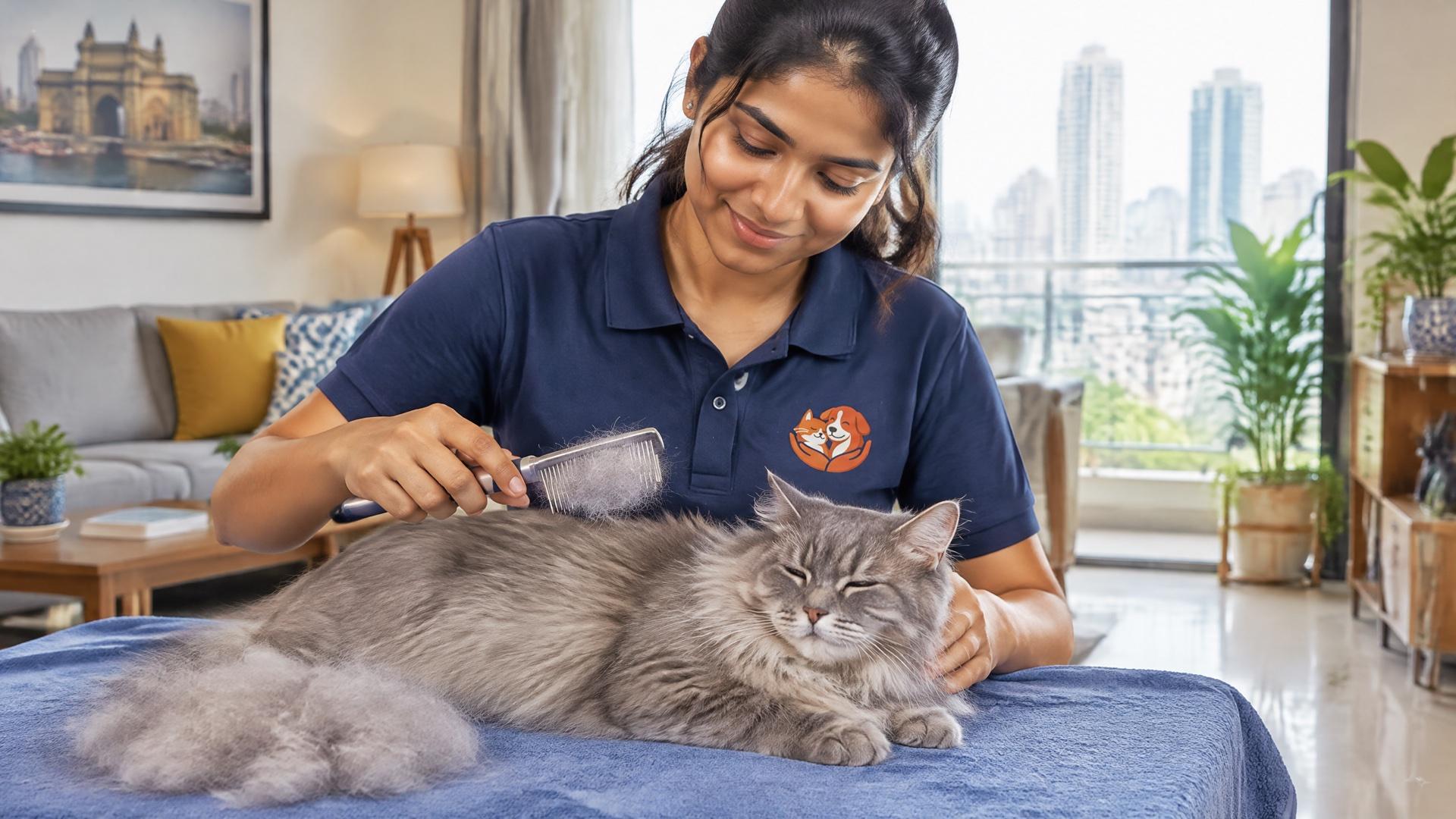
Most cat shedding is normal coat replacement, but bald spots, thinning fur or red, flaky skin mean something more is going on and your cat needs a vet. In a Mumbai flat, a little fur on the sofa is part of life with a cat, especially a long-haired one. If you're asking "why is my cat shedding so much?", this guide explains what's normal, what causes excess shedding or hair loss, why Persians shed in clumps and how to manage loose fur at home.
Key Takeaways
Shedding is a natural process. It's a concern when it leaves bald spots or a thin, patchy coat.
Indoor cats may shed steadily all year, and long-haired breeds such as Persians shed in noticeable clumps.
Fleas, allergies, stress, ringworm, hormonal problems and poor diet can all cause excess shedding or hair loss.
Let your vet rule out medical causes first, then brush regularly and check the skin as you go.
Why Is My Cat Shedding So Much?
Usually because shedding is a natural process that clears out dead hair. Cats Protection, a UK cat charity, explains in its article on why cats shed their fur that shedding is "a natural part of the hair growth cycle". It removes dead or damaged hair and helps prevent matting.
So how do you tell normal from too much? The Merck Veterinary Manual, a veterinary reference, gives a clear line in its owner guide to hair loss in cats: "Shedding may be abnormal (excessive) if it results in obvious loss of the hair coat and bald spots." Shedding without bald patches or symmetrical hair loss is likely normal coat replacement. Our advice: judge by your cat's coat, not the fur on the sofa.
Do Cats Shed More in Summer or All Year Round?
Not especially in summer: in cooler climates, cats tend to shed most in spring and autumn, while indoor cats may shed steadily all year. Cats Protection says the seasonal pattern "is due to changes in daylight and temperature, which trigger seasonal coat changes."
VCA Animal Hospitals, a network of vet hospitals, says in its guide to healthy coat and skin that cats in cooler climates, especially outdoor cats, have "two heavy, seasonal shedding cycles each year (late spring and late fall)".
Indoor cats are different. Cats Protection says they "may shed more consistently throughout the year rather than seasonally", because they're less exposed to natural light cycles. VCA notes that "many indoor cats shed at low levels all year-round."
None of these sources covers Mumbai's climate, so focus less on the calendar and more on whether the coat stays full.
Why Is My Persian Cat Shedding a Lot?
Because a Persian has a long, thick coat, and long coats shed in clumps that are hard to miss. The CFA (Cat Fanciers' Association), a US cat breed registry, describes the coat in its Persian breed profile as "long and thick, standing off from the body". It adds: "Owning a Persian calls for a serious commitment to regular grooming, and also to regular vacuuming!"
In its article on caring for fluffy coats, the CFA says fluffy cats shed in clumps that look like "furry tumbleweeds" rather than single hairs, with more of them in spring as cats lose their winter coats. It says "Persian and Exotic type coats will require daily grooming with a wide, metal comb."
So a Persian dropping tufts of fur is usually normal, as long as the coat underneath stays full. For the full daily routine, see our guide to Persian cat grooming at home.
Why Is My Cat Suddenly Shedding So Much?
Sudden heavy shedding or hair loss can have medical, dietary or stress-related causes, so it needs a vet check. The ASPCA, a US animal welfare charity, says "A variety of medical, dietary and stress-related issues can cause your cat to lose more hair than is normal."
Fleas, Mites and Other Parasites
International Cat Care, a feline welfare charity, calls flea allergic dermatitis "One of the most common causes" of over-grooming in its guide to over-grooming in cats. In a guide to compulsive disorders in cats, VCA's veterinary behaviourists say "Most cats with alopecia have an underlying skin disorder such as fleas or other external parasites."
Allergies
The PDSA, a UK vet charity, lists "fleas, atopy (allergic skin disease) and food allergies" as causes of itchy skin in its guide to fur loss in cats. PetMD, a pet health site, adds food, environmental and medication allergies.
Stress and Overgrooming
Stress is a real cause, but it's one your vet confirms only after ruling out others. Merck says "Excessive grooming (usually caused by stress) can cause hair loss in some cats", and the PDSA says "many cats will over groom and develop bald patches when they are stressed".
VCA's behaviourists, though, say stress-related hair loss is diagnosed only after "ruling out or treating possible underlying medical causes". Never assume it's just stress.
Infections and Hormonal Problems
The ASPCA lists ringworm (a fungal infection), bacterial infection and "Hormonal imbalance such as hyperthyroidism". Merck's vet-facing page on skin problems in animals says "A common cause of abnormal shedding is bacterial pyoderma", a bacterial skin infection.
The PDSA says hyperthyroidism (an overactive thyroid) "can sometimes cause alopecia". VCA's guide to hyperthyroidism in cats says it typically affects cats that are "middle-aged or older", causes weight loss despite a bigger appetite, and that their "fur may appear unkempt".
Diet and Pregnancy
The ASPCA lists "Poor diet" and "Pregnancy or lactation". VCA says a poor diet leads to a dull, dry coat and may cause excessive shedding, and that diet should suit your cat's life stage and health.
What Does Unhealthy Cat Fur Look Like?
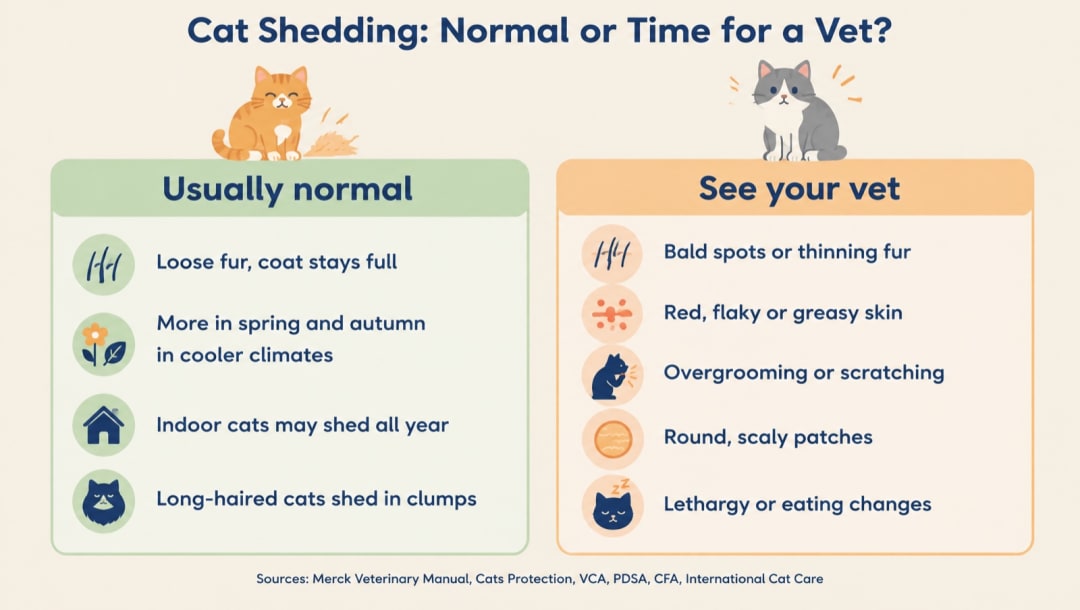
Unhealthy fur looks dull, dry, thin or patchy, often with flaky, greasy or sore skin underneath. VCA says "A healthy coat should be shiny and smooth, not coarse or brittle", and healthy skin is "supple and clear, not greasy, flaky, or bumpy".
Watch for:
dull, dry fur, dandruff, greasiness or an odour (VCA)
fur loss showing as "bald spots, patchy fur or as a generally thin coat" (PDSA)
"red, irritated or flaky skin" or "excessive grooming or scratching" (Cats Protection)
bare patches that are "often symmetrical", on the belly, inner hind legs and flank (International Cat Care, which says to "Contact your veterinary team as soon as possible")
Does Mumbai's Monsoon Affect Your Cat's Coat?
It may raise the risk of ringworm, a fungal infection that causes hair loss, though no source shows that humidity makes cats shed more. A 2015 study from Kolkata, published in the journal Veterinary World, found that fungal skin infections in dogs and cats were "more prevalent in the rainy seasons", and linked this to India's "warm and humid climate".
VCA's guide to ringworm in cats says it may show only as "cigarette ash" scaling, or as round patches of hair loss on the head, chest, forelegs or back. The PDSA says it "causes circular patches of flaky, red, itchy, furless skin".
VCA warns that ringworm "can be easily transmitted to humans, particularly children", and that long-haired breeds can carry it without showing signs. Our advice: if you spot round, scaly patches, see your vet promptly and mention any children at home.
How Do You Deshed a Cat at Home?
Rule out medical causes with your vet, then brush regularly, check the skin as you brush and vacuum often. For how often each coat type needs brushing, baths and nail care, see our guide on how often a cat should be groomed.
1. Check With Your Vet First
The ASPCA's shedding advice applies once a vet has ruled out medical causes. Any bald patch or skin change goes to the vet before you treat it as a grooming job.
2. Brush on a Steady Schedule
Cats Protection says "Long-haired cats will need a daily groom to prevent matted fur", and short-haired cats about once a week. The ASPCA suggests every few days for long-haired indoor cats. Regular brushing removes loose fur before it falls out, Cats Protection says.
3. Check the Skin as You Go
The ASPCA suggests looking for "hair loss, redness, bumps, cuts, fleas, ticks or other parasites" while grooming.
4. Ask Your Vet About Diet and Flea Control
The ASPCA advises: "Feed him a healthy, balanced diet." Because flea allergy is such a common cause of overgrooming, flea control matters too. Our advice: ask your vet which food and flea control suit your cat rather than switching on your own.
5. Vacuum Regularly
The ASPCA says regular grooming and vacuuming "should minimize the inconvenience of shedding".
Common Mistakes to Avoid
Treating bald spots or a thinning coat as normal shedding.
Assuming hair loss is "just stress" before your vet has checked for fleas, allergies and infection.
Skipping brushing because a cat is short-haired or lives indoors.
Changing food or starting flea treatment without asking your vet.
When Should You Call a Groomer or a Vet?
Call a groomer for loose fur and tangles on healthy skin, and your vet for any hair loss, skin change or sign that your cat is unwell.
Call a groomer when:
your long-haired cat sheds heavily but the coat is full and the skin looks healthy
loose fur and tangles build up faster than you can brush them out
Call a vet when:
you see bald spots, thinning fur or symmetrical bare patches
the skin is red, flaky, greasy or itchy, or there are round, scaly patches
your cat is overgrooming, scratching or licking much more than usual
problems come back quickly after grooming, which VCA says need a vet exam
your cat is lethargic or eating or drinking differently, which the PDSA says to report
PetMD says hair loss "isn't considered a medical emergency" but advises seeing a vet "within a few days". The ASPCA says to consult your vet "immediately" about excessive hair loss or bald patches. Our advice: book a vet visit soon, and treat it as urgent if your cat is unwell, losing weight or off food.
Can a Professional Groom Help With Cat Shedding in Mumbai?
Yes, for loose fur on a healthy cat. FurDial's Snip & Purr package (₹1,799, about 60 minutes) includes deep combing to clear tangles and loose fur. It also covers a bath with shampoo for sensitive feline skin, a calm blow dry, a full body haircut agreed before starting, ear, eye and paw cleaning, nail clipping and sanitary cutting.
For lighter upkeep between grooms, The Glow Up (₹1,199, about 45 minutes) is a dry bath with waterless shampoo or foam (no water or dryer), plus ear, eye and paw cleaning and nail clipping.
A FurDial groomer comes to your home across Mumbai, Thane, Navi Mumbai and Vasai-Virar (see the areas we cover), so there's no cage and no car ride. Every groomer has 5+ years of experience, products used are logged, GST is included and there's no travel charge. You can pay after the service by UPI or cash, or pay online.
Only cats with up-to-date core vaccinations can be groomed. Heavy matting may carry a small surcharge, told on arrival before starting, and if your cat is anxious, mention it in the booking note. A groomer is not a vet, so any hair loss or skin problem needs your vet first. See all grooming packages and prices.
Frequently Asked Questions
Does Brushing Help With Hairballs?
Yes. The ASPCA says regular grooming reduces hairballs, so the daily or weekly brushing above helps with both loose fur and hairballs.
Do Older Cats Shed More?
None of the vet sources used here says so. VCA does say arthritis and obesity can stop cats grooming themselves, so an older cat's coat may need more help from you.
Can a Cat Lose Hair After Being Ill?
Yes. Merck says "Significant hair loss is common in cats after respiratory infections." Mention any recent illness to your vet.
Final Thoughts
Shedding is normal, even heavy shedding in a Persian, as long as the coat stays full and the skin stays healthy. Bald spots, thinning fur, sore skin or overgrooming need your vet.
For loose fur and tangles on a healthy cat, book a FurDial groom at home and a groomer will come to you.