
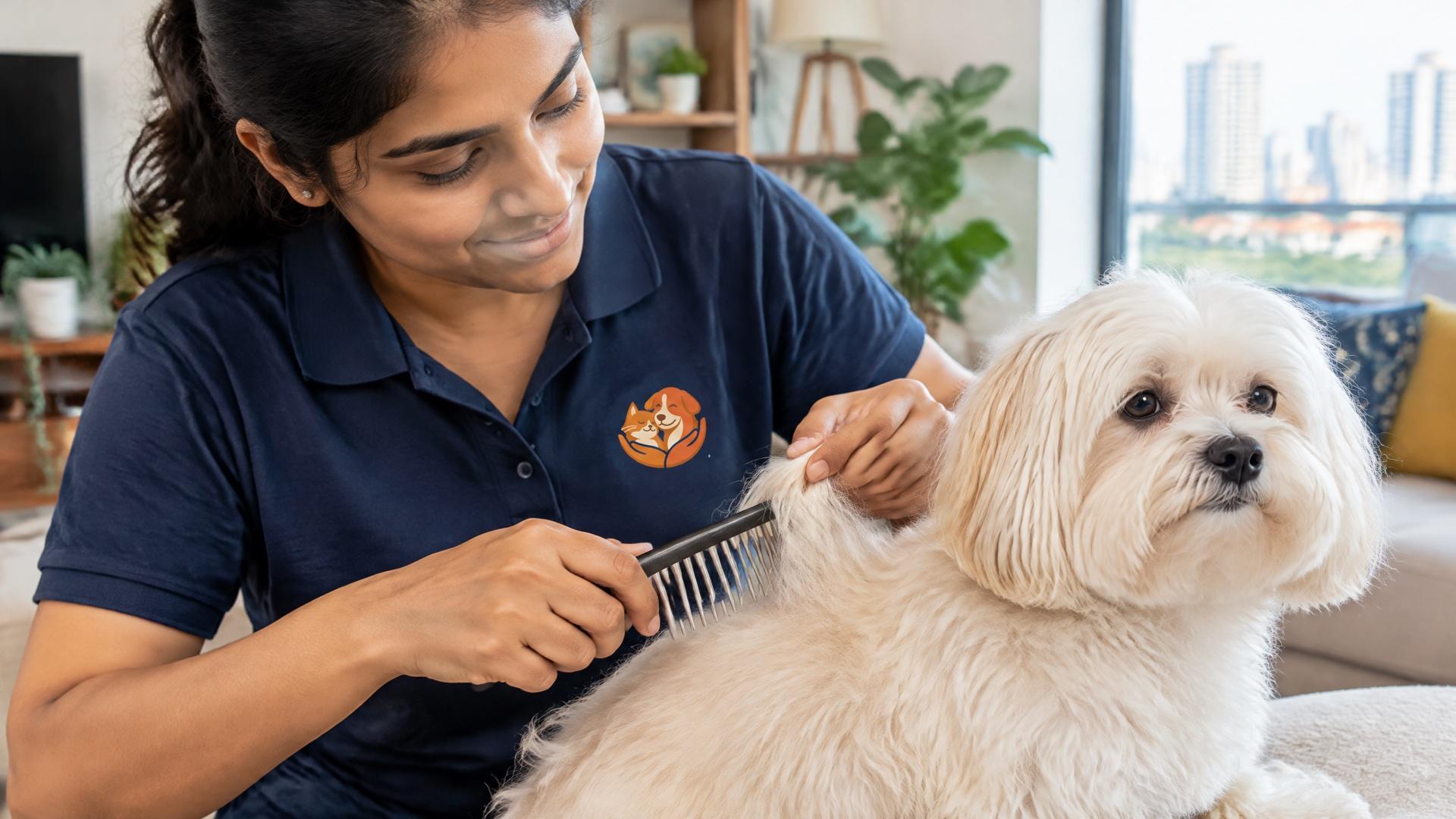
Mats are tight clumps of tangled loose hair that can pull on your pet's skin and hurt, so tease out only small, loose knots at home with your fingers and a comb, never use scissors, and leave tight or widespread mats to a groomer or vet. In Mumbai, rain and damp days can make tangles worse, so a fluffy coat in a Bandra or Vasai flat can knot faster than you expect. This guide to mats in cat fur and matted dog hair explains where they form, why they hurt and how to deal with them safely.
Key Takeaways
Mats form where fur rubs: behind the ears, armpits, groin, legs, tail and under collars or harnesses.
Mats can pull the skin, trap moisture, hide fleas and ticks, and lead to skin infection.
Tease out only small, loose knots at home. Never cut mats out with scissors.
Tight or severe mats need a groomer or vet, and sore skin underneath needs a vet.
What Are Mats in Cat and Dog Fur?
Mats are dense clumps of loose hair that have tangled together close to the skin. PetMD's vet-written guide to handling matting in dogs and cats, by Dr Jenny Alonge DVM, explains that "Matting happens when loose hair tangles, forming tight, dense clumps in your dog's or cat's coat."
Where Do Mats Form on Cats and Dogs?
Mats usually form where fur rubs or folds. PetMD lists behind the ears, under the legs and armpits, around the collar or harness, between the toes, and around the tail and hindquarters.
For cats, VCA Animal Hospitals, a network of vet hospitals, says in its guide to cat grooming and coat care to check under the armpits, in the groin and behind the ears for tangles. International Cat Care, a UK cat welfare charity, adds in its guide to grooming your cat that another common area is "between the toes and pads".
For dogs, VCA's guide to dog grooming and coat care names the same hotspots. The PDSA, a UK vet charity, calls "the armpits, legs, tummy, and tail" danger zones for matting in its guide to how often to groom your pet.
Why Does My Dog or Cat Have Hair Knots?
Hair knots form when loose fur gets trapped and rubbed together, usually through friction, moisture, shedding or a long, thick coat. PetMD explains:
Friction: "Mats often start in areas that rub against collars, harnesses, bedding, or even other parts of the body."
Moisture: bathing, swimming, rain and dampness from licking can make tangles worse.
Shedding: "Loose undercoat can become trapped in the outer coat, creating mats."
Coat type: "Long-haired and thick-coated dogs and cats are naturally more prone to mats."
The PDSA notes that curly coats are "more prone to knotting and tangling, especially if they get wet". That makes Mumbai's monsoon a time to keep a closer eye on curly and fluffy coats.
Why Older or Overweight Cats Get Matted
VCA says arthritic pain may stop an older cat grooming herself properly, and an overweight cat "may have difficulty reaching certain areas" of her body.
International Cat Care's guide on spotting signs of pain in cats says "Cats with joint pain may also develop matts in their coat as they cannot position themselves comfortably to groom." So a cat that suddenly looks scruffy and matted should see a vet, not just a comb.
Do Mats in Cat Fur Hurt?
Yes, mats can hurt because they pull on the skin as they tighten. PetMD says a growing mat "can pull the surrounding hair and skin", and can trap moisture and debris against the skin, leading to irritation and "potentially a skin infection".
The ASPCA, a US animal welfare charity, explains in a haircut could save a life that "mats are extremely uncomfortable" and that:
"Even very mild hair mats can cause skin irritation and progress to infected lesions."
Fleas and ticks "can live deep in the hair mat", out of sight.
Severe mats "can cause strangulating wounds, most often seen on an animal's limb".
How to Remove Matted Cat Hair Without Cutting
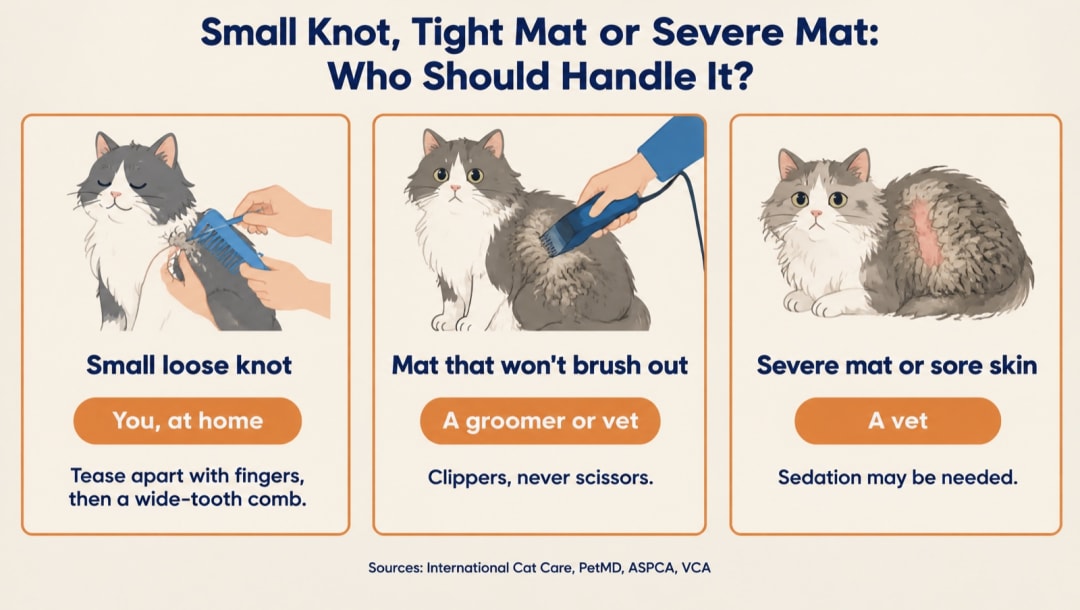
Tease a small, loose knot apart with your fingers, then work through it gently with a comb. This is for small tangles only. The PDSA goes further and advises, "Don't try to tackle matts at home," so if you're unsure, or the knot is tight, large or close to the skin, leave it to a groomer or vet.
1. Check the Knot and the Skin
Feel whether the knot is small and loose, and look at the skin. VCA says "If a mat has caused any skin irritation, take your cat to your veterinarian."
2. Tease It Apart With Your Fingers
International Cat Care says "If you come across a matt, tease it apart gently using your fingers", working patiently from the root towards the tip.
3. Work Through With a Comb or Slicker Brush
Next, PetMD suggests a wide-tooth comb or slicker brush. The RSPCA, a UK animal welfare charity, advises in its guide to how and why to groom your cat: "Tease any knots gently with the comb to avoid damaging the skin." VCA warns to "avoid excessive pulling on tangles".
4. Stop If It Won't Come Out Easily
If the knot doesn't loosen easily or your pet seems uncomfortable, stop and book a groomer or vet. For a cat that lashes out, see our guide to handling an aggressive cat during grooming.
Why Should You Never Use Scissors on Mats?
Scissors can easily cut your pet's skin, because mats sit close to it and pets move. The ASPCA warns: "NEVER cut mats out with scissors. Your pet can unexpectedly move or jerk resulting in a severe laceration or puncture."
International Cat Care says "it's extremely difficult to see where your cat's skin ends and the hair starts" in a badly matted coat. VCA says to "Only use clippers to remove mats", never scissors, and clipping a mat is a job for a groomer or vet, not a home task.
Should You Shave a Cat With Mats?
Yes, if the mats are severe, but leave it to a professional or your vet team, never a home job. International Cat Care says severe matts "will need to be shaved off by your veterinary team", which "often requires sedation or a general anaesthetic".
VCA says long-haired cats that mat often "may benefit from having their hair shaved down periodically", and that the cat "will require sedation during this procedure".
In PetMD's guide on whether to shave a cat for summer, Dr Hannah Hart DVM notes that "Shaving a cat can cause stress" and that shaved cats have a greater risk of sunburn.
How Can You Prevent Mats in Cats and Dogs?
Prevent mats with regular brushing, checks of the friction spots and thorough drying whenever the coat gets wet. PetMD says "The best way to handle mats is to prevent them from forming," through routine brushing, professional grooming and drying the coat thoroughly after baths.
The RSPCA says "Many long-haired cats need grooming every day." The PDSA advises drying pets thoroughly after they get wet, and PetMD notes that rain and dampness can make tangles worse, so dry the armpits, collar line and harness straps well after a wet monsoon walk.
For full routines, see our guides on how often to brush your dog and Persian cat grooming at home.
Common Mistakes to Avoid
Cutting mats out with scissors, even small ones.
Pulling a tight mat with a brush, which tugs the skin.
Bathing before detangling, which can make tangles impossible to remove.
Treating sudden matting in an older cat as laziness rather than a possible pain problem.
When Should You Call a Groomer or a Vet?
Call a groomer for mats that won't brush out easily, and a vet for severe mats or any sore, red or broken skin. The ASPCA says "If you notice a mat which cannot be easily brushed out, your pet should visit a groomer or veterinarian," and that severe matting "may require sedation and full body clipping".
Call a vet when:
the skin under a mat looks irritated, sore or broken
mats are severe, widespread or tight around a leg or the hind end
your cat has suddenly stopped grooming or looks scruffy, which can signal pain
Call a groomer when:
small mats keep coming back or won't brush out easily
the skin underneath looks healthy and your pet copes with handling
A groomer is not a vet. If you're unsure about the skin, see the vet first.
Can a Groomer Remove Mats at Home in Mumbai?
Yes, for mats where the skin underneath is healthy. FurDial's groomers come to your home across Mumbai, Thane, Navi Mumbai and Vasai-Virar, so there's no cage and no car ride. Every groomer has 5+ years of experience.
Dogs: The Full Flex, ₹2,399, about 120 minutes. Everything in Drip & Trim, plus anti-tick and flea treatment (grooming treatments, not a cure; heavy infestations need a vet), de-shedding to strip out dead undercoat, de-matting (tangles worked out by hand where kinder than clipping) and a calming massage.
Cats: Snip & Purr, ₹1,799, about 60 minutes. A bath with shampoo for sensitive feline skin, a calm blow dry, a full body haircut (zero cut, trim or styled finish, agreed before starting), ear, eye and paw cleaning, deep combing to clear tangles and loose fur, nail clipping and sanitary cutting.
How Much Does It Cost to Get a Matted Cat Shaved?
With FurDial, a matted cat is groomed under Snip & Purr (₹1,799), and a small surcharge may apply for heavy matting. The groomer tells you about it on arrival, before starting. If the mats are severe or the skin looks sore, see your vet first.
Prices include GST, with no travel charge, and you can pay after the service by UPI or cash, or pay online.
Only pets with up-to-date core vaccinations can be groomed. Mention an anxious or aggressive pet in the booking note, and the groomer may pause or reschedule if that is safer. See all grooming packages and prices and how an at-home groom works.
Frequently Asked Questions
Can I Bathe a Matted Dog?
Detangle first. VCA says tangles "can become impossible to remove after a bath", so brush them out before bathing.
What Happens After a Matted Cat Is Shaved?
The fur grows back over time. International Cat Care says cats that are severely matted may end up with fur only on the tail, head and lower legs until it regrows. PetMD notes that shaved cats have a greater risk of sunburn.
Why Does My Pet's Bottom Get Matted?
The tail and hindquarters are friction spots where mats often start, PetMD explains. The ASPCA warns that mats around the hind end can collect faeces, so ask a groomer or vet to clear them rather than cutting them yourself.
Final Thoughts
Mats in cat fur and matted dog hair can pull the skin, hide parasites and lead to infection. Tease out only small, loose knots, never reach for scissors, and let a groomer or vet handle anything tight or sore.
If your pet's coat needs a gentle comb-out at home, book a FurDial groom at home and mention any mats in the booking note.