
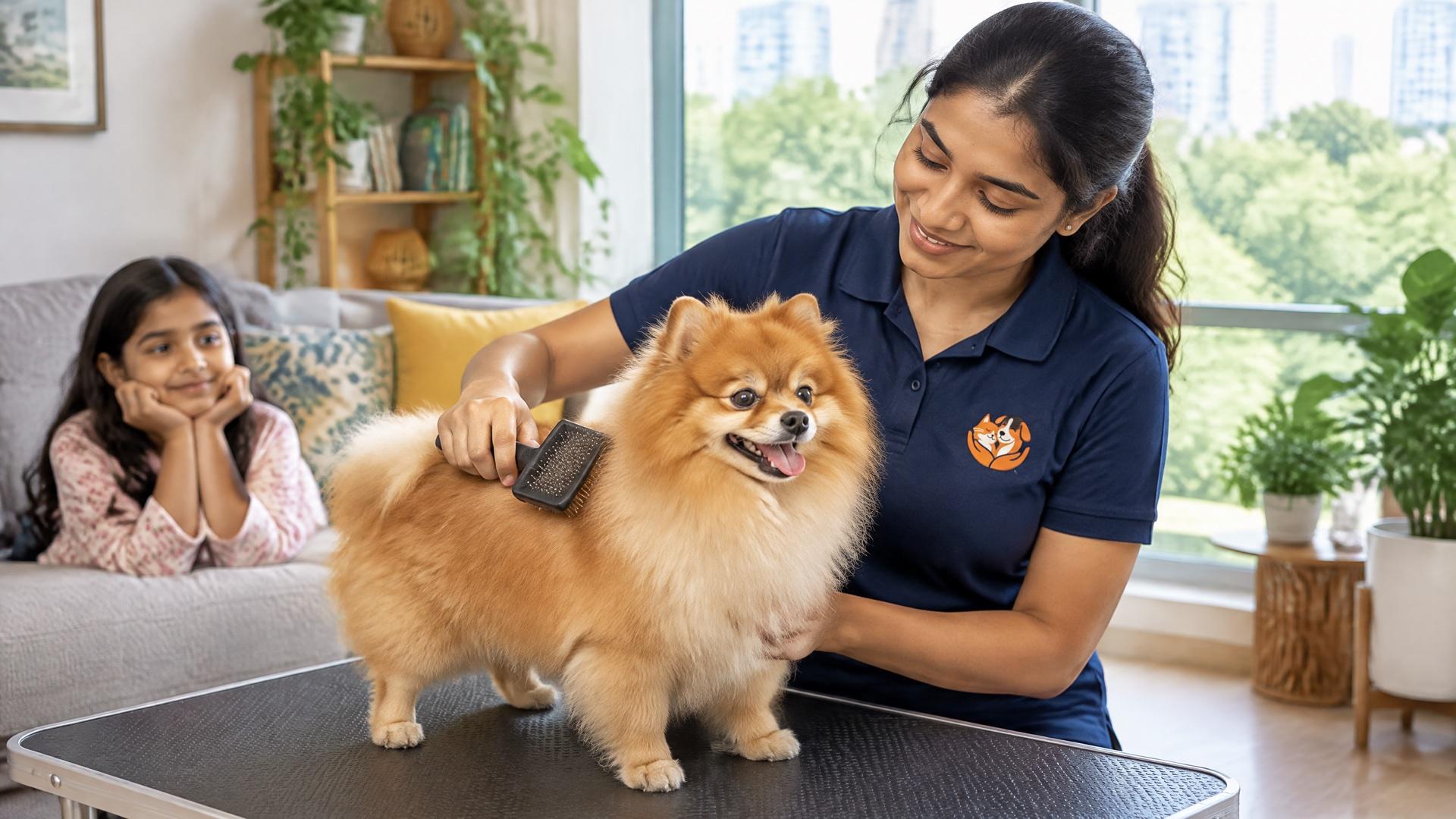
A Pomeranian should be brushed two or three times a week (daily when shedding), bathed every month or two, have its nails trimmed about once a month and see a professional groomer every four to six weeks. In Mumbai's humidity, a thick coat takes longer to dry and, as the AKC notes, can trap heat, so it needs extra care. How often should a Pomeranian be groomed for each task? Here's the full schedule, plus why a tidy trim is safer than a summer shave.
Key Takeaways
Brush two or three times a week, and every day when your Pom is shedding heavily.
Bathe every month or two, and dry the coat right down to the skin in Mumbai's humidity.
Book a professional groom every four to six weeks, as the AKC recommends.
Ask for a tidy trim, not a shave. If the coat doesn't grow back after clipping, see your vet.
How Often Should a Pomeranian Be Groomed?
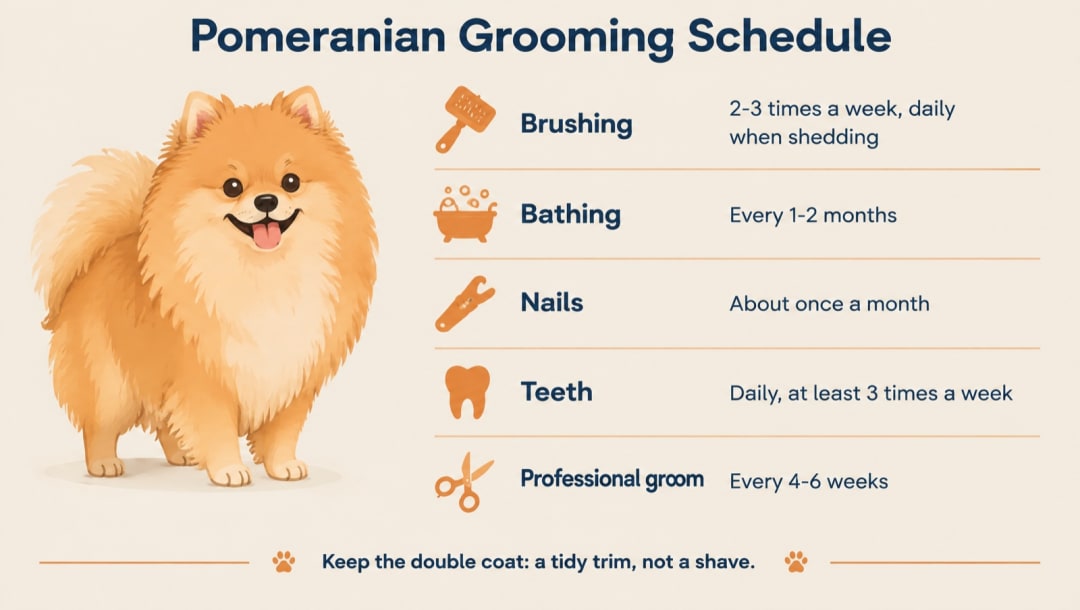
A Pomeranian should be professionally groomed every four to six weeks, with brushing, tooth care and quick checks at home in between. The American Kennel Club (AKC), a US pedigree dog registry, says the Pom's profuse double coat "requires somewhat diligent grooming", and that a professional groomer every four to six weeks "is highly recommended", in its guide to whether a Pomeranian suits you.
The schedule at a glance:
Brushing: two or three times a week, daily when shedding.
Bathing: every month or two, for dogs without a history of skin disease.
Nails: about once a month.
Teeth: daily if you can, three times a week at the very least.
Ears and eyes: check when you brush.
Professional groom: every four to six weeks.
Why Does a Pomeranian's Double Coat Need So Much Care?
Because it has two layers, and the soft one tangles. The American Pomeranian Club, in a breed flier hosted by the AKC, describes a "soft, dense undercoat with a profuse harsh-textured outer coat". The flier says brushing "a couple of times a week avoids matting".
VCA Animal Hospitals, a network of veterinary hospitals, explains in its guide to hot spots in dogs that matted fur "prevents air from reaching the skin" and "retains water".
How Often Should a Pomeranian Be Brushed?
Two or three times a week, and daily during heavy shedding. The sources agree on the range:
PetMD, a vet-reviewed pet health site, says "at least two or three times a week", and daily during shedding seasons.
The PDSA, a UK vet charity, suggests "brushing two-three times per week, and more often when shedding".
The AKC's guide to grooming a double-coated dog lists the Pom as an "Arctic" double coat and suggests a slicker brush, then a comb, "at least once a week". Our guide on how often you should brush your dog covers other coat types.
How to Brush a Pomeranian at Home, Step by Step
You'll need a slicker brush and a comb.
1. Brush in Small Sections
A master groomer writing for PetMD describes line brushing: work on one small section at a time. "Push the coat up with your hand to the line of the skin, pat the brush into the hair." Then follow with a comb, as the AKC suggests. If it catches, you've found a tangle the brush missed.
2. Check Where Mats Form
The same groomer notes that mats form "behind the ears, in the armpits." Our advice: if a knot won't tease out, don't pull it; leave it for a professional groomer.
How Often Should a Pomeranian Be Bathed?
Every month or two for most Poms. PetMD says "Dogs without a history of skin disease can usually be bathed every month or two." The AKC warns that "Bathing too often can deplete your dog's natural oils."
In Mumbai, drying matters as much as washing. Our advice: brush out tangles first, then dry right down to the skin with a low-heat dryer and a brush, and part the fur to check the base. Humid air makes this take longer, and damp, matted fur is what VCA links to hot spots.
How Do You Care for a Pomeranian's Nails, Teeth, Ears and Eyes?
Trim nails about once a month, brush teeth daily if you can, and check ears and eyes regularly, cleaning only when needed.
Nails
The AKC says to "keep a Pomeranian's nails short." VCA's guide to trimming a dog's nails suggests approximately once a month, or about every three weeks for dogs that spend little time on hard surfaces. Clicking on a hard floor means the nails are too long. Don't forget the dewclaws.
Teeth
The breed flier says "Poms' teeth tend to have a lot of tartar build-up", and PetMD says small breeds like the Pomeranian are "especially susceptible" to dental disease.
VCA advises brushing your dog's teeth at least once daily, with three times a week as the absolute minimum, using pet toothpaste only. It recommends a professional cleaning at least once a year, and notes that over 80 per cent of dogs over three years old have periodontal disease.
Ears
VCA's ear cleaning instructions say to clean only if there's discharge or an odour, warn that over-cleaning may cause irritation and advise against cotton buds. If the ears look red or painful, see your vet first.
Eyes and Tear Stains
PetMD notes that tear stains may be an issue for light-coloured Poms. If stains are new, its vet-written guide to dog tear stains advises a vet check. For everyday care, it suggests wiping away from the eye and keeping the hair around the eyes trimmed short. Leave trimming near the eyes to a professional groomer.
Should You Shave a Pomeranian in Summer?
No. Ask for a tidy trim instead, even in a Mumbai summer, unless matting or your vet makes a shorter clip necessary.
In the AKC's article on shaving a dog in summer, vet Dr Jerry Klein explains that the coat "acts as an insulator" and "protects him from sunburn". After shaving, the undercoat "will grow back faster, and sometimes will crowd out the slower-growing guard hairs", and there's a "possibility of follicle damage."
Texas A&M's veterinary school names Pomeranians among thick double-coated breeds. Its vet says shaving "may make it less tolerant of high temperatures" and is "not usually necessary unless there is matting involved". Trimming "should be done by a professional", and "Brushing is 100% recommended."
One source differs. The PDSA's heatstroke guide says to "Consider having your dog clipped" in warmer months if the coat is heavy. The sensible middle ground is a professional tidy trim that leaves the double coat in place, not a shave to the skin.
The AKC's guide to overheating in dogs notes that "In humid conditions, evaporation is less effective", and that thick or double coats can trap heat. Keep your Pom brushed out and cool, and call your vet straight away if you think it's overheating.
Why Isn't My Pomeranian's Coat Growing Back?
It may be slow regrowth after clipping, or a health condition such as Alopecia X. Only a vet can tell which.
Post-clipping alopecia is one possibility. In a 2004 article in dvm360, a veterinary trade publication, vet dermatologist Dr Carlo Vitale describes hair loss that "occurs after areas on the dog are clipped or shaved" in plush-coated Nordic breeds, which "usually regrow hair in six to 12 months." The article doesn't name the Pomeranian.
Alopecia X is another. VCA's guide to Alopecia X in dogs lists the Pomeranian among commonly affected breeds. It's also known as "black skin disease", and VCA notes the affected skin "often becomes darker". The hair loss is symmetrical and "usually not itchy". VCA calls it "mainly a cosmetic condition" but says "no treatment works for every dog."
VCA and Clinician's Brief, a journal for practising vets, both call Alopecia X a "diagnosis of exclusion", so your vet rules out other causes first, including hypothyroidism.
None of these sources says shaving causes Alopecia X, but a clipped double coat can be slow to return.
Common Mistakes to Avoid
Brushing only the top layer and missing the undercoat.
Leaving the coat damp at the base after a bath.
Asking for a shave to keep your Pom cool.
Waiting months to ask a vet about a coat that isn't growing back.
When Should You Call a Groomer or a Vet?
Call a groomer for a professional groom every four to six weeks or a tidy trim, and call your vet about anything that looks like a health problem. A groomer is not a vet.
Call a vet when:
the coat hasn't grown back after clipping, or you see symmetrical bald patches or darkening skin
your puppy has bare patches or red, scaly skin
tear stains are new, or the ears are red, painful, smelly or have discharge
a yearly professional dental cleaning is due
your Pom seems to be overheating (call urgently)
How Much Does Pomeranian Grooming Cost in Mumbai?
FurDial's at-home dog grooming starts at ₹1,699, GST included, with no travel charge. A groomer comes to your home anywhere in the areas we cover across Mumbai, Thane, Navi Mumbai and Vasai-Virar: no cage, no car ride, and you pay after the service by UPI or cash, or pay online.
Two packages suit a Pom best:
Drip & Trim, ₹1,999, about 120 minutes: everything in The Clean Aesthetic (₹1,699: deep conditioning bath, blow dry right down to the skin, brush out, nail clipping and filing, outer ear cleaning, and eye and paw cleaning), plus a full body haircut, a hygiene cut and an optional finishing perfume. The finish is agreed before starting, and coat condition decides what's achievable. Ask for a tidy trim, not a zero cut, unless matting or your vet requires one.
The Full Flex, ₹2,399, about 120 minutes: everything in Drip & Trim, plus de-shedding (a deeper pass to strip out dead undercoat), de-matting, anti-tick and flea treatment, and a calming massage. It suits a Pom in a heavy shed. Tick and flea treatments are grooming treatments, not a cure; heavy infestations need a vet.
Before you book:
Only pets with up-to-date core vaccinations can be groomed.
Heavy matting may carry a small surcharge, told on arrival before the groomer starts.
Mention anxiety in the booking note. The groomer may pause or reschedule if that's safer.
Every groomer has 5+ years of experience, and the products used are logged.
See all grooming packages and prices, or compare what pet grooming costs in Mumbai.
Frequently Asked Questions
What Age Should a Pomeranian Get Groomed?
Start brushing at home straight away. The AKC's guide to why puppies shed says to "get your puppy used to being brushed right from the beginning". No source we checked gives a set age for a first professional groom, so wait until your puppy's core vaccinations are up to date and ask your vet.
Expect an awkward phase. The same AKC guide says Pomeranians "can take up to 2 years to grow their adult coat in fully", and during "the uglies" the coat may look "ruffled, patchy, or shaggy".
What Is the Best Haircut for a Pomeranian?
A tidy trim that leaves the double coat in place, done by a professional. The breed flier mentions an optional paw-pad and sanitary trim. Avoid a shave unless matting or your vet makes it necessary.
Why Is My Pomeranian Losing So Much Hair?
It may be normal shedding. PetMD suggests brushing daily during shedding seasons, and the PDSA says to brush more often. Bald patches, symmetrical hair loss or darkening skin are not ordinary hair fall, so see your vet. For a full routine, see deshedding a dog at home.
Final Thoughts
Brush a few times a week, dry thoroughly after baths in Mumbai's humidity and look after those teeth. Choose a tidy trim over a shave, and take any patchy coat to your vet.
If you'd like help with de-shedding, drying or a tidy trim, book a FurDial groom at home and a groomer will come to you.